
Status — Updated November 21, 2026
New: Cinnamon 30mg 7-OH tablets are in stock while supplies last, shipping to 21 states. For the dated scheduling record, see the 7-OH Ban Timeline. 21+ only.
Whether you type it Press'd, Pressd, or Pressed 7OH, you're looking at the same brand — one of the earlier names in the 7-OH tablet category, distributed through third-party kratom retailers nationwide. This guide covers what Press'd sells and, more importantly, how to verify any pressed 7-OH tablet before you buy it. (Favor'd Alkz is not affiliated with Press'd; we compete in the same category.)
For context: 7-hydroxymitragynine occurs naturally in kratom leaf — typically about 2% or less of the leaf's alkaloid fraction (Takayama 2004) — the same molecule as, but categorically different in quantity from, the concentrated 7-OH products whose sales ended industry-wide in September 2026 (FDA).
What Press'd sells
Per retailer listings at the time of writing, Press'd is known for extra-strength flavored 7-OH tablets at 40 mg per tablet, in flavors including Original, Mint, and White Grape, sold in small-count packs (4–5 ct) at roughly $24 per pack at one retailer. Retailer descriptions credit Press'd as an early entrant that built its extract tablets on specific plain-leaf strain profiles. Availability varies by retailer — at least one listing we reviewed was marked discontinued, so check current stock where you shop.
The verification gap
Press'd products are sold almost entirely through third-party retailers, and at the time of writing we could not locate a dedicated Press'd brand site publishing lot-matched certificates of analysis. Some retailers provide lab documentation for the brands they carry; some don't. That puts the verification burden on you, and the checklist is always the same four items:
- Lot-matched: the COA's batch number matches the one printed on your package;
- Accredited: the report names an ISO/IEC 17025-accredited laboratory;
- Quantified: 7-OH is stated in mg per tablet, comparable to the label;
- Full panel: potency plus residual solvents and heavy metals.
A pressed tablet's look and flavor tell you nothing about content — only the certificate does. Our consumer's guide to reading a kratom COA shows how to run this check in under a minute.
How Favor'd Alkz answers the same question
Every Favor'd Alkz batch is tested by an ISO/IEC 17025-accredited lab with a full safety panel — the capsule COA is published and other certificates are available on request by email. Our former 7-OH tablets and powders (retired September 24, 2026) and the current full-spectrum lineup are labeled to tested values, so what's on the package is what's on the certificate — the standard we'd tell you to demand from Press'd, from us, from anyone.
Regulation status (August 2026)
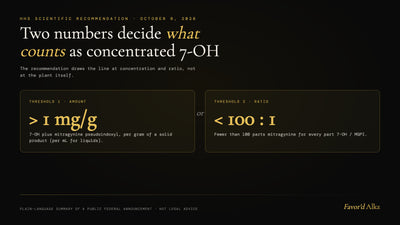
The DEA first published notices of intent on July 6, 2026 to temporarily schedule 7-OH above 0.05% concentration or 1 mg per article. On October 14, 2026 the DEA withdrew that notice and published a new one (91 FR 65370) with a different threshold: more than 1 mg of 7-OH per gram of product, or a mitragynine-to-7-OH ratio below 100:1. No scheduling order has been published; the earliest one can issue is November 13, 2026. Our running tracker covers which 7-OH brands are still shipping.
Press'd FAQ
Is it Press'd, Pressd, or Pressed?
All three spellings refer to the same 7-OH tablet brand; the apostrophe just drops out of search queries.
How strong are Press'd 7OH tablets?
Retailer listings show 40 mg of 7-hydroxymitragynine per tablet in the extra-strength flavored line.
What's a comparable alternative with published lab results?
Apply the four-item checklist above to any brand. Our 7OH alternative guide walks through the full comparison method, format by format.
FDA Disclaimer: The statements made regarding these products have not been evaluated by the Food and Drug Administration. These products are not intended to diagnose, treat, cure, or prevent any disease. All products are intended for adults 21 and older.
Research & sources: kratom leaf chemistry and 7-OH facts in this article are drawn from peer-reviewed literature and primary regulatory sources.
- FDA — 7-hydroxymitragynine — the federal view of 7-OH
- Favor'd Alkz Regulation Map — current state-by-state shipping status