
Status — Updated November 21, 2026
New: Cinnamon 30mg 7-OH tablets are in stock while supplies last, shipping to 21 states. For the dated scheduling record, see the 7-OH Ban Timeline. 21+ only.
Last updated October 14, 2026. Every state below was re-verified against the statute, regulation or order in October 2026; the primary source for each is linked at the end. Not legal advice.
Kratom law in the United States is a patchwork, and 2026 has been its busiest year. Four states added bans or scheduling, several more capped 7-hydroxymitragynine (7-OH) content, and dozens of cities and counties passed their own ordinances. This guide groups all 50 states and D.C. into four buckets so you can see the shape of it at a glance. For any single state, the interactive regulation map shows the current rule, the local ordinances we know of, and the source documents.
Banned statewide (12)
Kratom, or its alkaloids mitragynine and 7-OH, cannot legally be sold in these states. In most of them possession is a crime as well.
- Alabama
- Arkansas
- California
- Connecticut
- Indiana
- Kansas
- Louisiana
- Massachusetts
- North Dakota
- Tennessee
- Vermont
- Wisconsin
Notes: Kansas (July 1, 2026) and Tennessee (July 1, 2026) are the newest statutory bans. Massachusetts placed all forms of kratom in Schedule I by emergency regulation effective August 28, 2026, for up to one year. North Dakota's HB 1628 (September 4, 2026) makes any extract or tablet above 0.05% 7-OH a Schedule I derivative and allows only licensed pure-leaf sales, with no licenses issued yet. California has not scheduled kratom, but the Department of Public Health treats every kratom and 7-OH product as adulterated under the Sherman Law and prohibits sale; enforcement includes seizures. Connecticut scheduled the plant, its extracts and 7-OH by regulation in spring 2026.
Restricted (12)
Kratom leaf is legal here, but a 7-OH or extract rule, a delivery or registration requirement, or a wave of local ordinances limits what can be sold or shipped.
- District of Columbia
- Florida
- Idaho
- Illinois
- Kentucky
- Missouri
- Nebraska
- Ohio
- Rhode Island
- Utah
- Washington
- West Virginia
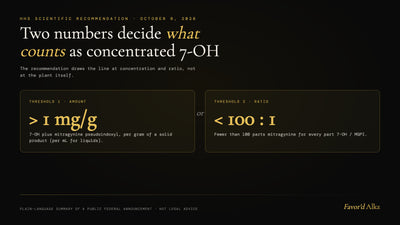
Examples: Florida's emergency rule (effective August 18, 2026) treats products above 1 mg of 7-OH per gram, or with fewer than 100 parts mitragynine per part 7-OH, as Schedule I. Kentucky makes 7-OH above 400 ppm dry weight a Schedule I substance (March 12, 2026) and bans all kratom sales on July 1, 2027. Ohio's Board of Pharmacy rule reaches 7-OH in any extract, tincture or tablet; only leaf in vegetation form is exempt. Utah allows only pure-leaf kratom sold in person at licensed tobacco retailers (May 6, 2026). Rhode Island legalized kratom through licensed stores but prohibits delivery to consumers (April 1, 2026). Nebraska and West Virginia require product registration before sale. Idaho, Illinois, Washington and Missouri have no statewide restriction but a growing list of city and county ordinances.
Consumer-protection (KCPA) states (15)
These states regulate kratom as a consumer product: an age minimum (18 or 21), labeling rules, a bar on synthetic alkaloids, and in most cases a cap on 7-OH as a share of total alkaloids (usually 2%; 1% in Oklahoma and Mississippi).
- Arizona
- Colorado
- Delaware
- Georgia
- Maryland
- Mississippi
- Nevada
- New York
- Oklahoma
- Oregon
- South Carolina
- South Dakota
- Texas
- Virginia
- Wyoming
Watch the caps that go beyond the percentage test. Georgia, Maryland and Virginia each limit 7-OH to 1 mg per serving (Virginia's law took effect July 1, 2026; Maryland's seizure rule the same day). Mississippi caps 7-OH at 0.5 mg per container. Delaware's new act (September 8, 2026) is age-only, 21+. New York is 21+ now and adds mandatory package disclosures on December 19, 2026, with a bill limiting 7-OH per serving awaiting the Governor.
No state law (12)
No statute, rule or order addresses kratom or 7-OH at the state level. Several of these states automatically adopt federal scheduling changes, and most have had bills introduced.
- Alaska
- Iowa
- Maine
- Michigan
- Minnesota
- Montana
- New Hampshire
- New Jersey
- New Mexico
- North Carolina
- Pennsylvania
Hawaii placed 7-OH in Schedule I by emergency scheduling order effective September 22, 2026, for any kratom product above 0.05% 7-OH by weight or 1 mg of 7-OH per unit (HRS § 329-11(e)); the order lapses unless the 2027 Legislature enacts it. We no longer ship to Hawaii.
Minnesota is the one state here with an age law only (21+, effective August 1, 2026). Michigan, New Jersey, Pennsylvania and Iowa all have ban or scheduling bills that advanced in 2026 without passing; Pennsylvania's HB 2657 passed the House 202–0 on October 5 and is pending in the Senate.
What changed in 2026
- Mar 12 — Kentucky 7-OH 400 ppm Schedule I rule.
- Apr 1 — Rhode Island Kratom Act: licensed retail only, no consumer delivery.
- Spring — Connecticut schedules kratom, extracts and 7-OH.
- May 6 — Utah pure-leaf-only law (SB 45).
- Jun 17 — New York 21+ sales law in force.
- Jul 1 — Kansas and Tennessee bans; Virginia 1 mg per serving limit; Maryland 1 mg per serving seizure rule.
- Aug 1 — Minnesota age raised to 21.
- Aug 18 — Florida emergency 7-OH rule.
- Aug 28 — Massachusetts emergency Schedule I placement of all kratom.
- Sep 4 — North Dakota HB 1628 extract bar and licensed leaf regime.
- Sep 8 — Delaware Kratom Consumer Protection Act (21+).
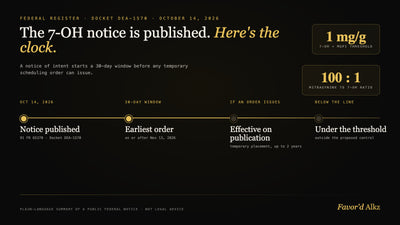
- Oct 14 — DEA publishes the federal 7-OH notice of intent (details).
Local ordinances count too
A legal state can still contain cities or counties that ban sale, delivery or possession. In October 2026 that includes parts of Idaho (Bonneville and Bingham counties, Coeur d'Alene), a dozen Illinois cities, Warren in Michigan, St. Joseph and Excelsior Springs in Missouri, Franklin in New Hampshire, Dutchess and Nassau counties in New York, and several Washington cities. The regulation map lists them by state, and our shipping policy explains which ones affect delivery.
How to read any state's rule
- Is the plant or its alkaloids scheduled? If mitragynine or 7-OH is on a controlled-substance list, the state is a ban regardless of product form.
- Is there a 7-OH cap? Percentage-of-alkaloid caps (2% is common) describe natural leaf ratios; per-serving or per-gram caps are stricter and can exclude extracts.
- Is there a form rule? Some states allow only leaf in vegetation form, or bar extracts outright.
- Is there a sales-channel rule? Licensed-retail-only or no-delivery rules matter for anything bought online.
- Check the city and county. Then check again next month.
Primary sources by state
- Alabama — Ala. Code § 20-2-23(b)(4)b — Mitragynine (322) + Hydroxymitragynine (323) Schedule I
- Alaska — AK ch. 22 SLA 2018 (HB 312) — AS 11.71.125 AG emergency scheduling (federal-listed substances only)
- Arizona — A.R.S. § 36-795.02 — Kratom products: 7-OH ≤2% of alkaloids, no synthetic alkaloids, 18+
- Arkansas — ADH List of Controlled Substances (Code of Ark. Rules Part 705) — Schedule I(c)(24)-(25) Mitragynine / 7-Hydroxymitragynine
- California — CDPH Food & Drug Branch letter to Processed Food Registrants (Jan 9 2026) — kratom/7-OH adulterated under HSC 110555
- Colorado — CO SB25-072 'Daniel Bregger Act' — C.R.S. 6-1-740 (Session Laws 2025 Ch. 283)
- Connecticut — CT DCP Regulation PR2025-018 — RCSA § 21a-243-7(c)(44),(47): 7-OH + kratom (leaves/stem/extracts) Schedule I, eff. 4/2/2026
- Delaware — 16 Del. C. Ch. 30U — Kratom Consumer Protection Act (21+ sale/marketing), eff. 9/8/2026
- District of Columbia — 22-B DCMR § 1201.1(h)(16) — '(Kratom) 7-hydroxymitragynine' Schedule I (DOH regulation)
- Florida — FL AG Emergency Rule 2ER26-2 — 7-OH Schedule I above 1 mg/g or MIT:7-OH <100:1 (eff. 8/18/2026)
- Georgia — GA HB 181 (2024) enrolled — O.C.G.A. § 16-13-121/-122 caps (150 mg MIT, 0.5 mg/g, 1 mg/serving), eff. 1/1/2025
- Hawaii — HI Dept. of Law Enforcement emergency scheduling order (HRS § 329-11(e)), effective Sep 22 2026 — 7-OH above 0.05% or 1 mg per unit in Schedule I
- Idaho — Idaho Code § 37-2702(d) — Board of Pharmacy federal-conformity duty (no state kratom law)
- Illinois — 720 ILCS 642/5 — Kratom Control Act (under-18 only)
- Indiana — IC 35-31.5-2-321(1)(LL),(HHH) — 7-hydroxymitragynine and mitragynine 'synthetic drug' definition
- Iowa — Iowa Code § 124.201(4) — Board of Pharmacy federal-conformity designation
- Kansas — KS HB 2365 (2026) enrolled — 7-OH to Schedule I, K.S.A. 65-4105(b)(32), eff. 7/1/2026
- Kentucky — 902 KAR 55:015 § 1(2)(c) — 7-OH above 400 ppm dry weight = Schedule I (eff. 3/12/2026)
- Louisiana — LA Act 41 of 2025 (SB 154) enrolled — 7-OH + mitragynine Schedule I(G); R.S. 40:966.1 kratom offense, eff. 8/1/2025
- Maine — 17-A M.R.S. § 1102 — Schedules W/X/Y/Z (no mitragynine/7-OH listed)
- Maryland — MD Alc. Bev. & Cannabis § 1-323 (Ch. 354/355 of 2026, eff. 7/1/2026) — >1 mg 7-OH/serving or >2% products seizable
- Massachusetts — 105 CMR 726.000 — Temporary Placement of Kratom in Schedule 1 (eff. 8/28/2026, 1 year)
- Michigan — MCL 333.7204 (as amended by 2026 PA 48) — federal scheduling auto-adopted within 60 days
- Minnesota — MN 2026 Laws ch. 63 (H.F. 3453) — § 152.027 subd. 7 sale/possession age 21, eff. 8/1/2026
- Mississippi — MS HB 1077 (2025) — kratom product = 7-OH ≤1% of alkaloids AND ≤0.5 mg/container; 21+; eff. 7/1/2025
- Missouri — 19 CSR 30-1.002 emergency amendment (DHSS) — MGPI/MGM-15/MGM-16 Schedule I, eff. 9/25/2026 (Mo. Register 10/15/2026)
- Montana — MCA § 50-32-203 — Board of Pharmacy 30-day federal conformity
- Nebraska — NE LB 230 (2025) — Kratom Consumer Protection Act, Neb. Rev. Stat. §§ 71-3801–71-3816
- Nevada — NRS 597.998 — kratom products (AB 303, 2019): under-18 bar, label, $1,000 penalty
- New Hampshire — RSA 318-B:1-a — commissioner scheduling; 30-day federal conformity (no kratom listing)
- New Jersey — N.J.S.A. 24:21-3(c) — 30-day federal conformity unless Director objects
- New Mexico — NMSA § 30-31-3 — Board of Pharmacy discretionary federal conformity (FindLaw)
- New York — NY PHL § 1399-xx — kratom sales to under-21 prohibited; 21+ signage (eff. 6/17/2026)
- North Carolina — NC G.S. 90-88(d) — Commission conformity to federal scheduling
- North Dakota — ND HB 1628 (2026 Special Session) enrolled — NDCC 19-03.1-05(3)(lll) + ch. 51-38, eff. 9/4/2026
- Ohio — OAC 4729:9-1-01.1 — Mitragynine-related compounds Schedule I (eff. 5/19/2026)
- Oklahoma — 63 O.S. § 1-1432.4 — Kratom Consumer Protection Act (7-OH ≤1% of alkaloids, 18+, labels)
- Oregon — OR HB 4010 (2022) enrolled — Oregon Kratom Consumer Protection Act (ORS 475.392–475.404)
- Pennsylvania — PA Controlled Substance, Drug, Device and Cosmetic Act (Act 64 of 1972) — § 3 scheduling powers; no kratom in § 4 schedules
- Rhode Island — R.I.G.L. § 11-9-13.23 — delivery of kratom to retail purchasers prohibited (eff. 4/1/2026)
- South Carolina — SC S. 221 / 2025 Act No. 35 — South Carolina Kratom Consumer Protection Act (21+, labels, no fully synthetic alkaloids), eff. 7/11/2025
- South Dakota — SD HB 1056 (2025) enrolled — SDCL 34-20B-115 (21+) and 34-20B-115.1 (7-OH ≤2%, labels), eff. 7/1/2025
- Tennessee — TN Public Chapter 950 (HB 1649) — 'Matthew Davenport's Law', kratom possession/sale offenses, eff. 7/1/2026
- Texas — TX SB 497 (88R, 2023) enrolled — Kratom Consumer Health and Safety Protection Act (now H&S Code ch. 445)
- Utah — UT SB 45 (2026, ch. 480) enrolled — Kratom Regulation Act: pure-leaf only, 7-OH ≤0.4% of alkaloids, RTSB retail, 21+; 7-OH Schedule I; eff. 5/6/2026
- Vermont — VT Dept. of Health Regulated Drug Rule — § 7.0 lists mitragynine and 7-hydroxymitragynine
- Virginia — Va. Code § 59.1-200(A)(77) (2026 c. 595, HB 360) — kratom prohibited practices: 21+, label, 7-OH ≤1% and ≤1 mg/serving, no synthetic; eff. 7/1/2026
- Washington — RCW 69.50.201(d) — 30-day federal conformity incl. 811(h) temporary orders
- West Virginia — W.Va. Code § 19-12F-3 (as amended by SB 985, eff. 6/12/2026) — kratom definitions
- Wisconsin — Wis. Stat. § 961.14(7)(mk) Mitragynine / (mL) 7-hydroxymitragynine — Schedule I
- Wyoming — WY SF0056 (2026) enrolled — SEA 44, Session Laws ch. 68: W.S. 35-7-2201–2203 Kratom Product Regulation (21+, 7-OH ≤2% of alkaloids), eff. 7/1/2026
Educational information only — not legal advice and not a substitute for reading the statute or rule yourself. Laws change quickly; verify current status with the state before you buy, sell, or travel with kratom. Must be 21+. These statements have not been evaluated by the Food and Drug Administration. These products are not intended to diagnose, treat, cure, or prevent any disease.