
Status — Updated November 21, 2026
New: Cinnamon 30mg 7-OH tablets are in stock while supplies last, shipping to 21 states. For the dated scheduling record, see the 7-OH Ban Timeline. 21+ only.
Search "7OH alternative" and you get a wall of affiliate pages that never define the question. It has three real meanings: people looking for a different brand of 7-OH than the one they have, people looking for a different format (tablet vs shot vs drink mix), and people new to the category comparing 7-OH against other kratom-derived products. This guide answers all three the same way the rest of our review series does — with published, independently checkable lab data, not marketing copy. ("7OH" and "70H" are just no-space spellings of 7-OH, 7-hydroxymitragynine; they mean the same thing.)
The one test that sorts every 7OH alternative
Status update — September 4, 2026: The analogues named in DEA-1644 — mitragynine pseudoindoxyl, MGM-15 and MGM-16 — are no longer sold by Favor’d ALKz, and those products have been withdrawn from sale. DEA-1570 concerns 7-OH and is a separate docket. Timeline statements elsewhere on this page describe the position as at the date they were written and may not reflect the current record. For current state-by-state status see our Kratom Regulation Map. Informational only; not legal advice.
Before comparing any two products, apply a single filter: can the brand show a lot-matched, full-panel certificate of analysis from an accredited lab for the exact batch you are buying? Not a potency-only screenshot, not a certificate for a different lot, not "lab tested" on the label with nothing behind it. A full panel covers potency plus residual solvents plus heavy metals, and the lab should be ISO/IEC 17025-accredited and named. Our piece on the case for third-party lab verification walks through what that panel catches that a label never will. Every brand comparison below is downstream of this one question.
Format is the biggest variable
The independent testing project TestMyKratom has published enough results across brands to show a clear pattern: format predicts label accuracy more than brand name does. Pressed tablets have tended to hold closest to their stated milligrams; liquids and drink mixes have shown the widest swings — sometimes 80–90% under label on the same brand whose tablets tested fine.
| Format | What the public record shows | Why |
|---|---|---|
| Pressed tablets | Generally closest to label (single-digit to ~18% variance) | Dry, uniform, easy to dose per unit |
| Liquid shots | Widest shortfalls seen (up to 82–90% under) | Alkaloids can settle or degrade in suspension |
| Drink mixes | Varies sharply flavor to flavor | Blending uniformity across a batch |
| Sublingual strips | Potency often close; watch residual-solvent flags | Solvent-based manufacturing |
The practical takeaway: if you are switching to a 7OH alternative because your current product feels inconsistent, changing format — especially moving to a pressed tablet with a per-lot COA — is often a bigger lever than changing brand.
Comparing brands honestly
We review individual 7-OH brands one at a time, against their own published lab data, and publish the results whether they flatter a competitor or not. If you are weighing a specific brand as your alternative, start with the independent record for it. Our brand reviews so far include Hydroxie (tablets tested respectably; shots did not) and LD7 / LabDirect7, with more in the series. For any brand not yet covered, look it up on TestMyKratom and apply the certificate test above.
How Favor'd Alkz compares
Since we were one of the brands this category compared, here is our standard stated plainly: every Favor'd Alkz batch is tested by an ISO/IEC 17025-accredited laboratory on a full safety panel — potency, residual solvents, heavy metals — and the tested value is what goes on the label. Our 7OH tablet lineup (labeled strengths from roughly 13 mg to 84.9 mg per tablet) was retired on September 24, 2026; its lot-matched certificates are archived and available on request by email. The lineup we ship today is full-spectrum, naturally derived kratom tablets and liposomal capsules with naturally occurring 7-OH — see the current collection, with the capsule COA published on our lab results page.
7OH Alternative FAQ
What is the best 7OH alternative?
There is no single "best" — the honest answer is: the product whose brand can hand you a lot-matched, full-panel COA from an accredited lab for the batch in your hand, in a format with a good accuracy record (pressed tablets, on the public data). Judge alternatives by that certificate, not by marketing.
Is 7OH the same as 7-OH?
Yes. "7OH," "70H," and "7-OH" are all spellings of 7-hydroxymitragynine, a naturally occurring alkaloid of the kratom plant. Different retailers write it different ways; it is the same compound.
How do I choose a 7-OH website to buy from?
Buy from a site that publishes lot-matched, full-panel certificates from a named ISO/IEC 17025 lab, states the tested potency on the label, ships only to states where 7-OH is legal, and gates sales to adults 21+. If a 7-OH website cannot show you the certificate for the specific lot you are ordering, that is the answer.
Are tablets a better 7OH alternative than shots or drink mixes?
On the published independent data, pressed tablets have held closest to their labeled milligrams, while liquid shots and drink mixes have shown the largest and most variable shortfalls. That does not condemn every liquid, but if consistency is why you are switching, a per-lot-tested tablet is the safer default.
Is 7-OH affected by the DEA's 2026 notice?
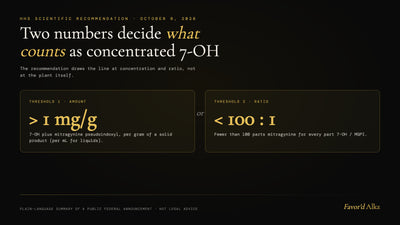
The DEA's temporary-scheduling thresholds as written in the October 14, 2026 notice (more than 1 mg of 7-OH per gram, or a mitragynine-to-7-OH ratio below 100:1) sit far below every full-strength 7-OH product the market sold. August 5, 2026 was the earliest possible effective date; Favor'd Alkz paused 7-OH tablet sales on September 24, 2026 regardless, reopening 7-OH tablets through Restricted Access in 21 states on October 12 — see the 7-OH Ban Timeline for the current record.
One fact worth keeping straight as you compare products: 7-hydroxymitragynine occurs naturally in kratom leaf only as a trace alkaloid — typically about 2% or less of the leaf's alkaloid fraction — chemically the same molecule as, but categorically different in quantity from, the concentrated 7-OH products whose sales ended industry-wide in September 2026.
Research & sources: kratom leaf chemistry and 7-OH facts in this article are drawn from peer-reviewed literature and primary regulatory sources.
- Takayama (2004), Chem. Pharm. Bull. — alkaloid profile of Mitragyna speciosa; 7-OH ≈2% of the alkaloid fraction
- FDA — 7-hydroxymitragynine — the federal view of 7-OH
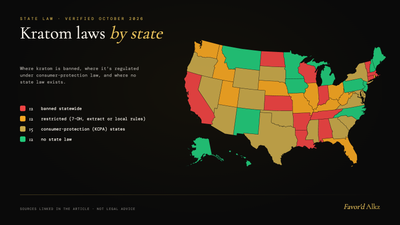
- Favor'd Alkz Regulation Map — current state-by-state shipping status
Related buying guides
Researching the category? Read how 7-OH buying worked and what to verify, see where to buy 7-hydroxymitragynine online, or compare the cheapest 7OH online by cost per mg. Searching “7OH near me”? See why lot-matched online ordering usually wins. If you prefer loose powder, read what “pure” 7OH powder means, what “raw” 7-OH actually means, or our bulk 7OH buying guide. See the current naturally derived lineup on our tablets page, see 7 OH tablet strengths and prices explained, learn how to judge the best 7OH brands, or run the 7OH online ordering checklist. Looking at a specific vendor? Start with the 7ohMitDistro checklist or the 7oh Factory checklist, or the 7OH Plus checklist.
Comparing formats? Start with our 7OH bottle guide (per-tablet cost by pack size), then see 7OH syrup vs tablets and 7OH vape vs tablets. Weighing a multi-brand reseller? Read the 7Tabz alternative guide.
This article is provided for informational and educational purposes only. It is not medical, legal, or financial advice, and nothing here should be read as a claim about the effects of any product. These statements have not been evaluated by the Food and Drug Administration. These products are not intended to diagnose, treat, cure, or prevent any disease.
For adults 21+ only. Keep all 7-OH products out of reach of children and pets. Check your state and local laws before purchasing.