
Raw 7-OH, Explained: What "Raw" Actually Means on a Label
Shop for 7-OH products long enough and you'll run into the word "raw": raw 7-OH powder, raw 7-hydroxy, raw extract. Sounds self-explanatory. It isn't. On a 7-OH label, "raw" is a format description — it tells you the product is a loose powder, not that it's pure and not that it came straight off a leaf. This guide covers what the word actually means, how raw powder differs from tablets as a product format, and how to check what's really in the jar using the certificate of analysis (COA). Everything here is educational. The only opinions are about paperwork.
TL;DR: "Raw 7-OH" almost always means unflavored, unpressed 7-OH powder sold by weight, as opposed to flavored pre-formed tablets. "Raw" does not mean "natural," and it says nothing about concentration; only a lot-matched COA does. Favor'd Alkz published COA-backed mg-per-gram figures on every powder it sold — Saffron Soul at 928 mg/g, OG 7ohBlack at 821 mg/g, Amber Moon at 612 mg/g — until the powder line was retired on September 24, 2026; archived lab reports are available on request by email, and the current capsule COA is published at /pages/lab-results. First order $150+? Code WELCOME25 takes $25 off.
What Does "Raw" Mean in Raw 7-OH?
When a vendor writes "raw," they mean 7-OH in loose powder form: nothing pressed, nothing flavored. It's the upstream format, the concentrated powder that tablet manufacturers start with before the flavor systems and compression excipients go in.
That's the honest definition. There's also a borrowed one. In food and supplement labeling, "raw" hints at minimal processing, and that hint does not survive contact with the chemistry here. Getting from plant material to a powder that assays in the hundreds of milligrams per gram takes extraction, refinement, and in many cases chemical conversion. So the word tells you the format and nothing more. Process, purity, source? Those live in a lab document, which we'll get to.
What Is 7-OH in the First Place?
7-OH is shorthand for 7-hydroxymitragynine, an alkaloid related to mitragynine, the primary alkaloid in the kratom leaf (Mitragyna speciosa). Structurally, it's mitragynine with a hydroxyl group added at the 7-position. That's the whole name, decoded.
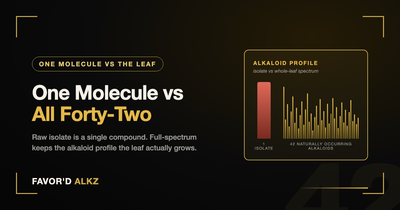
Here's the part that matters for shopping. The leaf carries 7-hydroxymitragynine only in trace amounts; commercial products run concentrations far beyond anything found in plant material. That makes the number on a label a manufacturing outcome, not a botanical constant. Two jars can both say "raw 7-OH" and hold very different alkaloid totals, and the only way to know which one you're holding is to read the COA for that specific lot.
Is "Raw" the Same as "Natural"?
No. This is the single most useful thing to know about the term. "Raw" describes an unpressed, unflavored powder format. It does not mean:
- Unprocessed. High-concentration 7-OH powder comes out of extraction and refinement, not out of grinding a leaf.
- Plant-derived at leaf-level ratios. The 7-OH concentrations in commercial powders vastly exceed what occurs naturally in kratom leaf.
- Verified. The word carries no testing requirement. A jar labeled "raw" has had exactly as much third-party analysis as its vendor chose to pay for. Maybe plenty. Maybe none.
None of that makes raw powder suspect. It just means a label adjective can't double as a purity claim. The purity claim lives in one place: a certificate of analysis from a named laboratory, matched to the lot in your hands. If a "raw" listing has no COA, the adjective is being asked to do the paperwork's job.
Raw 7-OH Powder vs. Tablets: What's the Actual Difference?
Strictly as product formats, four things separate them.
1. How quantity is expressed. Tablets are pre-formed units — a tablet product states its content per piece (our 30mg line carries the figure right in the product name), and the count on the bottle does the arithmetic for you. Raw powder sells by weight, with 7-OH content expressed as a concentration in milligrams per gram. A gram of Saffron Soul at 928 mg/g and a gram of Amber Moon at 612 mg/g are both "1g of raw 7-OH powder." The alkaloid totals inside are not remotely the same.
2. What else is in it. Tablets contain flavoring, sweeteners, and binders; that's what makes them tablets. Raw powder is typically neither flavored nor pressed, so the COA's potency figure describes nearly everything in the jar rather than the active fraction inside a formulated piece.
3. Who carries the precision burden. With tablets, the manufacturer fixed the per-unit quantity at the press. With powder, quantity is a function of weight, which puts even more load on the concentration disclosure. The label math only works if the mg-per-gram number is real.
4. Price structure. Tablets price per count; powder prices per gram. Comparing the two, or comparing two powders of different strengths, takes cost per milligram of disclosed 7-OH — a figure every Favor'd Alkz product page displays directly.
Neither format wins outright. Which one suits a given buyer is their call. Our job is publishing the numbers that keep the comparison honest.
How Do You Read a COA for Raw 7-OH Powder?
Open the lab report before checkout, not after. Five fields:
- Laboratory name. A named, independent lab — not an anonymous letterhead.
- Lot or batch number. It has to match the lot printed on the product you receive. A COA with no lot linkage could describe any batch from any year.
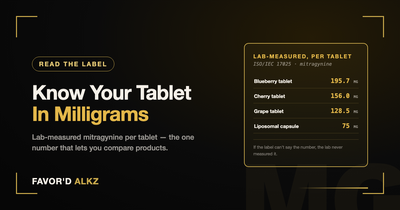
- Potency result. For raw powder, the mg-per-gram (or percentage) figure for 7-hydroxymitragynine. This number is the product's real spec sheet, not the marketing copy.
- Related alkaloids. Many reports also quantify mitragynine and other alkaloids, which tells you what the remaining fraction of the powder contains.
- Contaminant panels, where provided — heavy metals and microbial screens.
Then run the one-minute cross-check: does the concentration on the COA support the total mg claimed on the listing? A 1g jar of powder assayed at 928 mg/g contains 928 mg of 7-OH. If a listing's total-mg claim and its COA don't reconcile, believe the COA. The Favor'd Alkz capsule COA is published at /pages/lab-results and every other lot report is available on request by email, so you can run this exact audit on us before spending a dollar.
What Do Real Raw 7-OH Concentrations Look Like?
Numbers from the former Favor'd Alkz powder collection (retired September 24, 2026 — archived 2026 pricing), each drawn from its lot's COA:
- Saffron Soul — 928 mg/g (92.8% 7-OH). 1g $65, 3g $180, 5g $285, 10g $525, 20g $950.
- OG 7ohBlack — 821 mg/g (82.1%). 3g $169, 5g $269, 10g $495, 20g $899.
- Amber Moon — 612 mg/g (61.2%). 3g $145, 5g $229, 10g $415, 20g $749.
- White Velvet — a mitragynine powder, not 7-OH, disclosed the same way at 715 mg/g. 10g $121, 20g $215.
For high-volume buyers, 100g bulk jars run $999 (White Velvet), $3,050 (Amber Moon), $3,650 (OG 7ohBlack), and $3,850 (Saffron Soul).
Look at the spread in those concentrations. Three jars, all legitimately "raw 7-OH powder," ranging from 61% to 93% — a 1.5× difference in alkaloid content per gram. That spread is the whole argument for treating a "raw" label without a published assay as an incomplete product description.
Storing Raw Powder
The standard playbook for concentrated botanical powders applies: sealed airtight container, cool dry spot, away from direct light and humidity. Keep the original labeling intact so the lot number stays matched to its COA. Loose powder has far more surface area exposed to air and moisture than a pressed tablet, so the seal matters more in this format.
And as with every product in this category: locked away from anyone under 21, full stop.
What Should Raw 7-OH Cost?
Judge powder pricing in cost per milligram, not price per gram. A cheap jar at a low concentration can cost more per milligram than a pricier jar at a high one. Divide the price by (grams × mg-per-gram) and compare. Live Favor'd Alkz numbers: Saffron Soul's 20g jar is $950 for 18,560 mg of disclosed 7-OH, while the 1g entry point is $65 for 928 mg — same powder, same COA, different tier economics. Every product page in the collection shows the per-mg figure computed from the COA concentration. Tablet pages do the same. One division compares formats, or compares us against any other vendor's disclosed numbers.
Earlier in your research? Our vendor-evaluation guide covers the full checklist (COAs, potency disclosure, per-mg math) in depth: choosing a 7OH alternative. And if you're weighing an online purchase, see how to buy 7OH online for what compliant ordering should look like, from age verification to state-law screening.
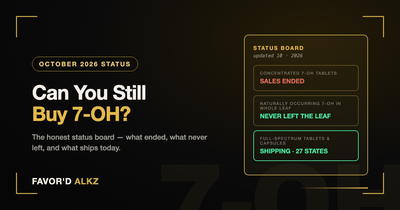
Ready to see the paperwork? Raw 7-OH powder is no longer sold here (retired September 24, 2026 — see the 7-OH ban timeline). Browse the lab-verified full-spectrum tablet & capsule lineup, and read the published capsule COA first at /pages/lab-results. New customers get $25 off their first order of $150+ with code WELCOME25.
This article is for informational purposes only. These statements have not been evaluated by the Food and Drug Administration. These products are not intended to diagnose, treat, cure, or prevent any disease. Products are intended for adults 21 years of age or older. Check your state and local laws before purchasing.
Research & sources: kratom leaf chemistry and 7-OH facts in this article are drawn from peer-reviewed literature and primary regulatory sources.
- Takayama (2004), Chem. Pharm. Bull. — alkaloid profile of Mitragyna speciosa; 7-OH ≈2% of the alkaloid fraction
- FDA — 7-hydroxymitragynine — the federal view of natural vs concentrated 7-OH
- Favor'd Alkz Regulation Map — current state-by-state shipping status