
Quick Answer
Raw 7-OH products were one isolated, concentrated molecule — and their sales ended industry-wide in September 2026. Full-spectrum kratom tablets contain the leaf’s complete naturally occurring alkaloid profile instead: at least 54 alkaloids identified in the literature, with the 42 best-documented listed, with citations, in the table below. Every Favor’d Alkz tablet is quantified on a 9-analyte ISO/IEC 17025 lab panel. 21+ only.
Two product categories, one plant, and a very different answer to the same question: what’s actually in this?
Through early 2026, shoppers compared raw 7-OH products — isolates built around a single concentrated molecule — against whole-leaf formats. That comparison is now historical. The one that matters today is between what raw 7-OH products were and what full-spectrum kratom tablets are: the leaf’s entire naturally occurring alkaloid profile, verified on an accredited lab panel. This article walks that chemistry, publishes the citation-backed list behind the “42 alkaloids” on our labels, and shows real COA numbers from a production batch. Identification and measurement only — no claims about what any compound does.
What “Raw 7-OH” Products Were
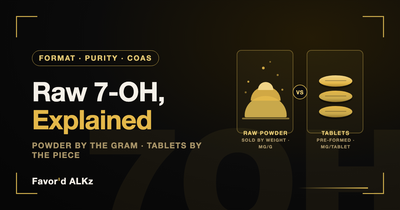
“Raw 7-OH” described a format: loose, unflavored, high-concentration 7-hydroxymitragynine powder — and the tablets pressed from it. The defining trait was isolation: one alkaloid out of the leaf’s dozens, extracted, refined, and concentrated far beyond anything the plant produces. In leaf, 7-hydroxymitragynine is a trace constituent — typically around 2% or less of the alkaloid fraction (Takayama 2004; FDA). Raw 7-OH inverted that ratio: the trace constituent became essentially the whole jar. The full format breakdown is in Raw 7-OH, Explained, and how an isolated molecule compares chemically to its leaf-borne counterpart is covered in our natural-vs-synthetic chemistry explainer — we won’t duplicate either here.
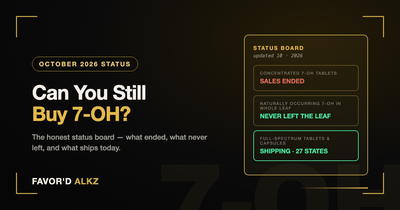
That era closed. Under DEA’s proposed scheduling action for 7-OH (docket DEA-1570, proposing thresholds of >1mg per article or 0.05% dry weight — final rule still pending), concentrated 7-OH sales ended industry-wide in September 2026; Favor’d Alkz processed its final 7-OH sale on September 24, 2026. What replaced it is not a tweaked isolate. It’s the other end of the spectrum entirely.
What “Full-Spectrum” Actually Means
A full-spectrum kratom tablet contains the leaf’s complete naturally occurring alkaloid profile, in the proportions the plant made it. Where a raw 7-OH product was defined by what was removed, a full-spectrum product is defined by what was kept.
How many compounds is that? The peer-reviewed record is specific: Flores-Bocanegra et al. (2020) report at least 54 alkaloids isolated and identified from Mitragyna speciosa. Mitragynine dominates, followed by paynantheine, speciogynine, and speciociliatine, with a long tail of minor and trace alkaloids — heteroyohimbines, N(4)-oxides, nine distinct oxindoles — and naturally occurring 7-hydroxymitragynine in its native place as a trace constituent, around 2% or less of the alkaloid fraction.
Our tablet line is named for 42 of those alkaloids — the subset we can put a specific name, class, and literature citation against, compound by compound. The label is deliberately conservative: the published record documents more alkaloids than we claim, not fewer. Here is the entire list.
The 42 Alkaloids, With Citations
This list is compiled from peer-reviewed literature only: Takayama 2004 (Chem Pharm Bull 52:916–928), Flores-Bocanegra et al. 2020 (J Nat Prod 83:2165–2177), Manwill et al. 2022 (Planta Med 88:838–857), Hanapi et al. 2021 (Front Pharmacol 12:751656), Chakraborty et al. 2021 (ACS Chem Neurosci 12:2661–2678), Veeramohan et al. 2023 (PLoS One 18:e0283147), and Kanumuri et al. 2026 (Pharm Biol 64:902–920), with abundance cross-checks against Cinosi et al. 2015 (BioMed Res Int 2015:968786). The literature reports at least 54 alkaloids isolated from M. speciosa; the 42 below are the best-documented named structures — no isomers were invented to pad the count. Abundance tiers: Major = mitragynine-class (~66% of the crude alkaloid fraction in Thai-origin leaf; ~12% in Malaysian-origin leaf, per Takayama 2004); Minor = roughly 0.5–10% of the alkaloid fraction; Trace = below that, or detected only in specific chemotypes or leaf stages. Scope: chemistry and identification only.
Legend: ◆ = alkaloid quantified on our ISO/IEC 17025 lab panel (bolded rows).
| # | Alkaloid | Class | Typical abundance | Source citation |
|---|---|---|---|---|
| 1 | Mitragynine ◆ | Indole (Corynanthe-type) | Major (~66% of alkaloid fraction, Thai origin; ~12% Malaysian) | Takayama 2004 Chem Pharm Bull; Flores-Bocanegra 2020 J Nat Prod |
| 2 | Paynantheine ◆ | Indole (Corynanthe-type) | Minor (~8.6%) | Takayama 2004 Chem Pharm Bull; Manwill 2022 Planta Med |
| 3 | Speciogynine ◆ | Indole (Corynanthe-type) | Minor (~6.6%) | Takayama 2004 Chem Pharm Bull; Manwill 2022 Planta Med |
| 4 | Speciociliatine ◆ | Indole (Corynanthe-type) | Minor (~0.8–8%, varies by origin/product) | Takayama 2004 Chem Pharm Bull; Manwill 2022 Planta Med |
| 5 | 7-Hydroxymitragynine ◆ | Indole (7-hydroxyindolenine) | Trace–minor (~2% of alkaloid fraction) | Takayama 2004 Chem Pharm Bull; Manwill 2022 Planta Med |
| 6 | Mitraciliatine | Indole (Corynanthe-type) | Minor | Flores-Bocanegra 2020 J Nat Prod; Manwill 2022 Planta Med |
| 7 | Isopaynantheine | Indole (Corynanthe-type) | Minor | Flores-Bocanegra 2020 J Nat Prod; Manwill 2022 Planta Med |
| 8 | Epiallo-isopaynantheine | Indole (Corynanthe-type) | Minor | Flores-Bocanegra 2020 J Nat Prod |
| 9 | Corynantheidine ◆ | Indole (Corynanthe-type) | Minor (~1%) | Takayama 2004 Chem Pharm Bull; Chakraborty 2021 ACS Chem Neurosci |
| 10 | 9-Hydroxycorynantheidine | Indole (Corynanthe-type) | Trace | Kanumuri 2026 Pharm Biol |
| 11 | Ajmalicine | Indole (heteroyohimbine) | Minor | Manwill 2022 Planta Med; Hanapi 2021 Front Pharmacol |
| 12 | Tetrahydroalstonine | Indole (heteroyohimbine) | Trace | Hanapi 2021 Front Pharmacol |
| 13 | Akuammidine | Indole (sarpagine-type) | Trace (MS-annotated) | Veeramohan 2023 PLoS One |
| 14 | Mitragynaline | Indole (C9-functionalized Corynanthe) | Trace (young leaves) | Takayama 2004 Chem Pharm Bull |
| 15 | Corynantheidaline | Indole (C9-functionalized Corynanthe) | Trace (young leaves) | Takayama 2004 Chem Pharm Bull |
| 16 | Mitragynalinic acid | Indole (Corynanthe carboxylic acid) | Trace (young leaves) | Takayama 2004 Chem Pharm Bull |
| 17 | Corynantheidalinic acid | Indole (Corynanthe carboxylic acid) | Trace (young leaves) | Takayama 2004 Chem Pharm Bull |
| 18 | Mitralactonal | Indole (9-methoxy, lactone-bearing) | Trace | Takayama 2004 Chem Pharm Bull |
| 19 | Mitralactonine | Indole (lactone-bearing) | Trace | Takayama 2004 Chem Pharm Bull |
| 20 | 9-Methoxymitralactonine | Indole (9-methoxy, lactone-bearing) | Trace | Takayama 2004 Chem Pharm Bull |
| 21 | Mitrasulgynine | Indole (sulfonate-bearing; first of its kind) | Trace | Takayama 2004 Chem Pharm Bull |
| 22 | 3,4,5,6-Tetradehydromitragynine | Indole (anhydronium base) | Trace | Takayama 2004 Chem Pharm Bull |
| 23 | Mitragynine-N(4)-oxide | Indole (N4-oxide) | Minor | Flores-Bocanegra 2020 J Nat Prod |
| 24 | Speciociliatine-N(4)-oxide | Indole (N4-oxide) | Minor–trace | Flores-Bocanegra 2020 J Nat Prod |
| 25 | Isopaynantheine-N(4)-oxide | Indole (N4-oxide) | Minor–trace | Flores-Bocanegra 2020 J Nat Prod |
| 26 | Epiallo-isopaynantheine-N(4)-oxide | Indole (N4-oxide) | Trace | Flores-Bocanegra 2020 J Nat Prod |
| 27 | Speciofoline | Oxindole (9-hydroxylated) | Minor (most abundant oxindole in some chemotypes) | Flores-Bocanegra 2020 J Nat Prod; Manwill 2022 Planta Med |
| 28 | Isospeciofoleine | Oxindole (9-hydroxylated) | Trace | Flores-Bocanegra 2020 J Nat Prod; Manwill 2022 Planta Med |
| 29 | Isorotundifoleine | Oxindole (9-hydroxylated) | Trace | Flores-Bocanegra 2020 J Nat Prod |
| 30 | Corynoxine (corynoxine A) | Oxindole | Minor | Flores-Bocanegra 2020 J Nat Prod; Chakraborty 2021 ACS Chem Neurosci |
| 31 | Corynoxine B | Oxindole | Minor | Flores-Bocanegra 2020 J Nat Prod |
| 32 | 3-Epicorynoxine B | Oxindole | Trace | Flores-Bocanegra 2020 J Nat Prod |
| 33 | Corynoxeine | Oxindole | Trace | Flores-Bocanegra 2020 J Nat Prod; Manwill 2022 Planta Med |
| 34 | Isocorynoxeine | Oxindole | Trace (young leaves) | Takayama 2004 Chem Pharm Bull |
| 35 | Rhynchophylline | Oxindole | Minor–trace | Manwill 2022 Planta Med |
| 36 | Isorhynchophylline | Oxindole | Trace | Hanapi 2021 Front Pharmacol; Veeramohan 2023 PLoS One |
| 37 | 3-Epirhynchophylline | Oxindole | Trace | Flores-Bocanegra 2020 J Nat Prod |
| 38 | Mitraphylline ◆ | Oxindole (pentacyclic) | Minor | Manwill 2022 Planta Med; Kanumuri 2026 Pharm Biol |
| 39 | Isomitraphylline | Oxindole (pentacyclic) | Minor–trace | Manwill 2022 Planta Med |
| 40 | Speciophylline | Oxindole (pentacyclic) | Trace | Manwill 2022 Planta Med |
| 41 | Mitragynine oxindole B | Oxindole | Trace | Hanapi 2021 Front Pharmacol |
| 42 | Mitragynine pseudoindoxyl ◆ | Other (spiro-pseudoindoxyl) | Trace (detected in some leaf extracts) | Hanapi 2021 Front Pharmacol; Kanumuri 2026 Pharm Biol |
Lab-panel note: our panel quantifies nine analytes. Eight appear in the table above (◆): mitragynine, 7-hydroxymitragynine, speciociliatine, paynantheine, speciogynine, corynantheidine, mitraphylline, and mitragynine pseudoindoxyl. The ninth, dihydro-7-hydroxymitragynine (MGM-15) ◆, is a mitragynine-derived transformation product quantified for product characterization; it is not counted among the 42 plant-identified alkaloids above, which keeps this list strictly literature-defensible.
Count note: the literature total is higher than 42 — Flores-Bocanegra et al. 2020 state at least 54 alkaloids have been isolated from M. speciosa, and Hanapi et al. 2021 cite roughly 45 identified. “42 alkaloids” is therefore a conservative, fully citable subset of the published record.
What Our Lab Actually Measures
No commercial lab panel quantifies 42 compounds — reference standards don’t exist for most trace alkaloids — so honest full-spectrum labeling means saying exactly what is measured. Our ISO/IEC 17025-accredited panel (BullsEye Testing) quantifies nine analytes per batch: mitragynine, 7-hydroxymitragynine, speciociliatine, paynantheine, speciogynine, corynantheidine, mitraphylline, mitragynine pseudoindoxyl, and MGM-15. The last three routinely report below detection limits in our products — which matters, because mitragynine pseudoindoxyl, MGM-15, and MGM-16 are named in DEA-1644 (in force, zero-threshold), and the panel verifies, batch by batch, that we sell none of them.
Here are the real numbers from the Blueberry tablet batch COA, per tablet:
| Analyte | mg / tablet |
|---|---|
| Mitragynine | 195.711 |
| Speciociliatine | 51.896 |
| Paynantheine | 29.594 |
| Speciogynine | 24.942 |
| Corynantheidine | 3.145 |
| 7-Hydroxymitragynine | 1.721 |
| Total measured alkaloids | 307.008 |
The shape matches the literature: mitragynine dominant, the other majors in their expected minor band, and naturally occurring 7-OH at 1.721mg — about 0.56% of the measured alkaloid fraction, inside the leaf’s documented trace range. That is full-spectrum on paper: the leaf’s ratios, measured, not a single amplified number. Current certificates are published at /pages/lab-results.
How to Read a Full-Spectrum Tablet Label
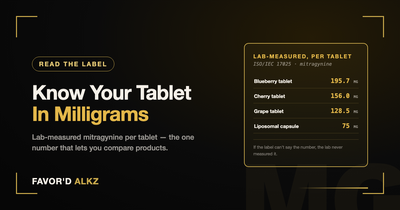
With an isolate, the label number was 7-OH milligrams. With a full-spectrum tablet, the anchor number is milligrams of mitragynine per tablet — the dominant alkaloid is the honest basis for comparison. Current per-tablet figures from batch COAs:
- Grape — 128.5mg mitragynine per tablet
- Cherry — 156.0mg mitragynine per tablet
- Blueberry — 195.7mg mitragynine per tablet
- Passion Fruit — figures publish when its batch COA finalizes
Three checks on any full-spectrum label, ours included: the mitragynine figure traces to a lot-matched COA from a named, accredited lab; the COA quantifies multiple alkaloids, not one headline analyte; and the per-tablet total reconciles with the per-analyte lines, as the 307.008mg Blueberry total does above. A “full-spectrum” claim backed by a single-analyte COA is an isolate wearing a different label.
The Full-Spectrum Lineup
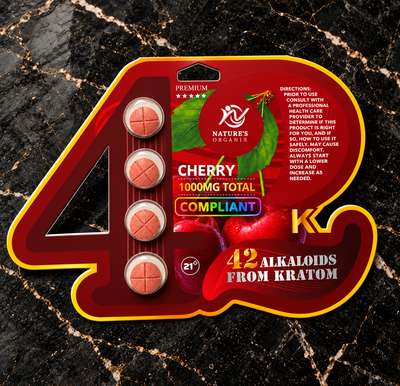
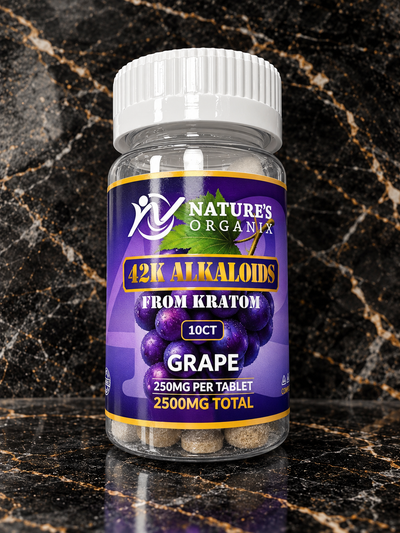
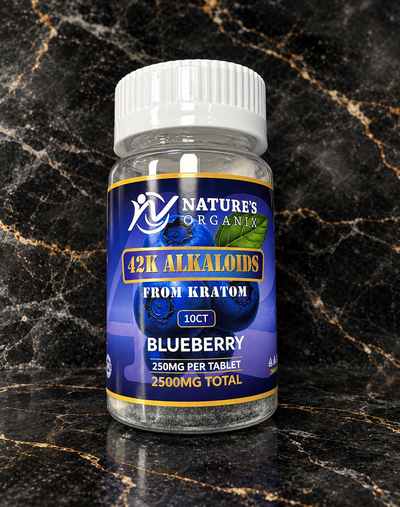
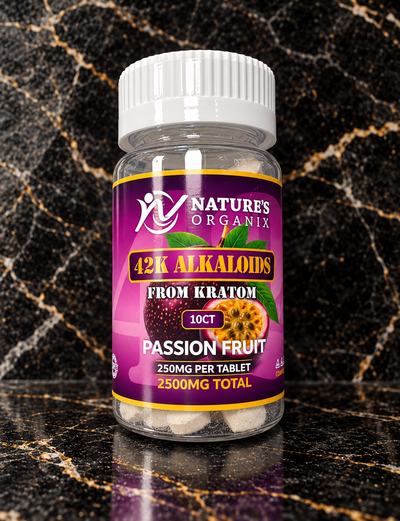
Nature’s Organix full-spectrum kratom tablets — the leaf’s naturally occurring alkaloid profile, quantified per batch on a 9-analyte ISO/IEC 17025 panel. 21+ only.
- Nature’s Organix Grape — 128.5mg mitragynine per tablet
- Nature’s Organix Cherry — 156.0mg mitragynine per tablet
- Nature’s Organix Blueberry — 195.7mg mitragynine per tablet
- Nature’s Organix Passion Fruit — batch COA figures publishing on finalization
Prefer a capsule? Nature’s Alks 75mg is the same full-spectrum profile in a liposomal capsule format.
FAQ
Does kratom really have 42 alkaloids?
It has more. Peer-reviewed literature documents at least 54 alkaloids identified in Mitragyna speciosa (Flores-Bocanegra et al. 2020). The 42 in our table are the best-documented named structures — the citable subset our tablet line is named for. The label count is conservative by design.
What is full-spectrum kratom?
A full-spectrum kratom product contains the leaf’s complete naturally occurring alkaloid profile in the plant’s own proportions — mitragynine dominant, minor and trace alkaloids intact, including trace naturally occurring 7-hydroxymitragynine — rather than one alkaloid isolated and concentrated.
What happened to raw 7-OH products?
Sales of concentrated 7-OH products ended industry-wide in September 2026 under DEA’s proposed scheduling action (docket DEA-1570; final rule still pending). Favor’d Alkz completed its final 7-OH sale on September 24, 2026, and now carries full-spectrum tablets and capsules only.
How much mitragynine is in each tablet?
Per current batch COAs: Grape 128.5mg, Cherry 156.0mg, Blueberry 195.7mg of mitragynine per tablet; Passion Fruit figures publish when its batch COA finalizes. Certificates live at /pages/lab-results.
Research & sources: kratom leaf chemistry and 7-OH facts in this article are drawn from peer-reviewed literature and primary regulatory sources.
- Takayama (2004), Chem. Pharm. Bull. — alkaloid profile of Mitragyna speciosa; 7-OH ≈2% of the alkaloid fraction
- Flores-Bocanegra et al. (2020), J. Nat. Prod. — at least 54 alkaloids identified in kratom leaf
- FDA — 7-hydroxymitragynine — the federal view of natural vs concentrated 7-OH
- Favor'd Alkz Regulation Map — current state-by-state shipping status
This article is for informational and chemical-identification purposes only. These statements have not been evaluated by the Food and Drug Administration. These products are not intended to diagnose, treat, cure, or prevent any disease. Products are intended for adults 21 years of age or older. Check your state and local laws before purchasing.