
Status — Updated November 21, 2026
New: Cinnamon 30mg 7-OH tablets are in stock while supplies last, shipping to 21 states. For the dated scheduling record, see the 7-OH Ban Timeline. 21+ only.
Search for 7Stax and you'll see it spelled three ways — 7Stax, "7 stacks," and "stax 7oh" — but it's one brand: a 7-OH tablet line sold on its own site and through category retailers. 7Stax is also one of the few competitors with a meaningful independent-testing paper trail, which makes it a useful case study in the question that should drive every 7-OH purchase: does the tested milligram number match the label? (Favor'd Alkz is not affiliated with 7Stax.)
The 7Stax lineup
7Stax sells 7-OH tablets across a wide strength range — 20, 30, 50, 80, 100, and 150 mg per tablet — from single tablets around $4.99 up to 500-count bulk boxes listed at $3,199.99, plus 50 mg shots. The brand's site includes a public Lab Reports link, which already puts it ahead of competitors that publish nothing.
What independent tests found
The independent database TestMyKratom lists results for a dozen 7Stax products. The pattern, per their published numbers:
7-OH tablets: under label, but in range
Several lots tested moderately below claim — an 80 mg Mint at 65.33 mg (82%), an 80 mg Mixed Berry at 67.81 mg (85%), a 20 mg Mint at 15.39 mg (77%), with 20–30 mg flavors as low as 67% of label.
Undeclared-alkaloid flags
Several lots — including a 100 mg Banana that measured 122.33 mg of 7-OH — were flagged for containing unadvertised MGM-15 (5.76–17.64 mg depending on lot). Those lots, and the Mitragynine Nano Tech tablets that tested at 28–29% of label, received failing grades in that database.
The fair caveats
These are single-lot samples, not the whole catalog; some 7Stax lots tested reasonably close to label, and the brand does publish lab reports. The takeaway isn't "avoid 7Stax" — it's that lot-to-lot variance and undeclared alkaloids are real in this category, so the certificate for your lot is the only one that matters. Our walkthrough on how to read a kratom COA shows exactly where unlisted alkaloids appear on a report.
How we handle the same question
Every Favor'd Alkz batch is tested by an ISO/IEC 17025-accredited lab — potency, residual solvents, heavy metals — with the capsule COA published and other certificates available on request by email. Our former 7-OH tablets (retired September 24, 2026) were labeled to tested values with every declared alkaloid quantified on the COA, and the current full-spectrum lineup follows the same rule. Current bundle pricing is on the deals page.
Regulation check (August 2026)
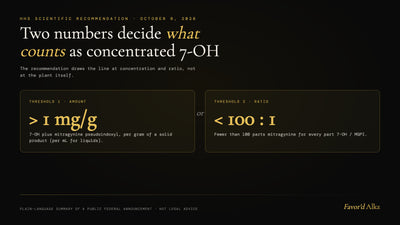
The DEA first published notices of intent on July 6, 2026 to temporarily schedule 7-OH above 0.05% concentration or 1 mg per article. On October 14, 2026 the DEA withdrew that notice and published a new one (91 FR 65370) with a different threshold: more than 1 mg of 7-OH per gram of product, or a mitragynine-to-7-OH ratio below 100:1. No scheduling order has been published; the earliest one can issue is November 13, 2026. Our tracker of 7-OH brands after the DEA announcement stays current as this develops.
7Stax FAQ
Is 7Stax the same as "7 stacks"?
Yes — "7 stacks" and "stax 7oh" are common spellings of the 7Stax brand name in search.
Does 7Stax publish lab results?
Yes, the 7stax.com site carries a Lab Reports link. Match the report's lot number to your package, and check whether alkaloids beyond 7-OH are quantified.
Why does an undeclared alkaloid matter?
MGM-15 (dihydro-7-hydroxymitragynine) is a distinct kratom-derived alkaloid. Some vendors sold it deliberately — Favor'd Alkz did, labeled and quantified with its own COA, before retiring those products in September 2026. The issue the independent tests flagged is different: it appeared unadvertised in lots labeled as plain 7-OH. An undeclared active is a labeling failure whatever the compound — and a full-panel, lot-matched COA is how you catch it.
One fact worth keeping straight as you compare products: 7-hydroxymitragynine occurs naturally in kratom leaf only as a trace alkaloid — typically about 2% or less of the leaf's alkaloid fraction — chemically the same molecule as, but categorically different in quantity from, the concentrated 7-OH products whose sales ended industry-wide in September 2026.
Research & sources: kratom leaf chemistry and 7-OH facts in this article are drawn from peer-reviewed literature and primary regulatory sources.
- Takayama (2004), Chem. Pharm. Bull. — alkaloid profile of Mitragyna speciosa; 7-OH ≈2% of the alkaloid fraction
- Flores-Bocanegra et al. (2020), J. Nat. Prod. — at least 54 alkaloids identified in kratom leaf
- FDA — 7-hydroxymitragynine — the federal view of 7-OH
FDA Disclaimer: The statements made regarding these products have not been evaluated by the Food and Drug Administration. These products are not intended to diagnose, treat, cure, or prevent any disease. All products are intended for adults 21 and older.