
In 2016, and again in 2018, a peculiar word surfaced on one of the most-downloaded podcasts in the country and started spreading through the cultural bloodstream of American men who lift weights, listen to long-form audio, and distrust the government's pharmacopeia: kratom. A lot of that diffusion can be traced to a single microphone. On The Joe Rogan Experience, the host returned to the topic across several episodes — most memorably #876 (2016) with documentarian Chris Bell, where Rogan reportedly tried kratom on the air, and #1136 (2018) with chemist and documentarian Hamilton Morris, a more chemically literate conversation about how the plant works. The recurring framing was consistent: kratom is a natural, plant-based leaf that can feel mildly stimulating in small amounts and sedating in larger ones, and the Drug Enforcement Administration's 2016 attempt to schedule it was an overreach.
That framing is now a media artifact worth examining on its own terms — not as an endorsement to ratify or condemn, but as a case study in how influential hosts shape what millions of people believe about a plant. Because here is the uncomfortable thing about the Rogan-era kratom conversation: parts of it have aged reasonably well, and parts of it have aged badly. Sorting which is which is an exercise in media literacy as much as pharmacology.
What the podcasters got right
Start with the credit, because it is real. The broad mechanistic claim that ran through these conversations — that kratom's effects are dose-dependent, and that its active compounds engage the body's opioid receptors — is consistent with peer-reviewed pharmacology. Kratom's two principal alkaloids, mitragynine and 7-hydroxymitragynine (7-OH), act at the mu-opioid receptor. A 2021 paper in Nature Communications mapped how site-selective chemical modifications of these Mitragyna alkaloids tune their signaling at that receptor, supplying a structural basis for why effects shift with molecule and amount. The casual on-air line that "it does different things at different doses" was, at the level of mechanism, broadly in the right direction.
Rogan was also right about something less technical: in the mid-2010s, kratom was genuinely understudied, and reflexive prohibition was premature. That instinct was vindicated, in a narrow way, in 2021, when the World Health Organization's Expert Committee on Drug Dependence reviewed kratom, mitragynine, and 7-OH and concluded there was insufficient evidence to recommend a critical review — the step that can lead to international scheduling. The committee kept the substances under surveillance, noting limited evidence of abuse liability in humans while acknowledging that regular use can cause dependence and withdrawal, and that high doses can produce serious toxicity.
It is tempting, in podcast retellings, to read that WHO outcome as exoneration. It was not. "Insufficient evidence to schedule" is a verdict about the thinness of the science, not a clean bill of health — a distinction worth holding onto, because it cuts both ways.
Where the framing breaks down
The trouble begins with a rhetorical move so common it is almost invisible: the slide from natural to therefore safe. Plants are not exempt from pharmacology. Dr. Suzette Glasner — a clinical psychologist, addiction scientist, and associate professor of psychiatry at UCLA's David Geffen School of Medicine — devoted an episode of her own podcast to critiquing exactly this slippage in Rogan's kratom commentary. Her framing, as she lays it out, is blunt: the biggest misconception is that "natural" means "safe." She notes that while kratom is not technically an opioid, it acts on the same mu-opioid receptors in the brain, and that clinicians are now seeing a rise in what they call kratom use disorder.
That clinical detail deserves careful handling, because it is easy to misread. The point Glasner is making is not a recommendation of any kind — it is a description of risk: a clinical signal that, for some people, kratom can produce dependence serious enough to bring them into treatment. Nothing in that observation suggests that kratom or 7-OH is itself a remedy for anything; the "it's basically coffee" register of podcast talk simply has no room for the downside.
And then there is the anecdote problem, which is really the central media-literacy lesson here. A great deal of what circulates about kratom on podcasts is personal testimony: a host or guest describing how a substance made them feel. When Rogan described trying kratom on air, that was an anecdote — a single self-report, not data. The peer-reviewed literature is explicit that many human claims about kratom rest on anecdotal accounts and self-report, while controlled human trials remain scarce. One person feeling fine after using kratom proves precisely nothing about population-level safety. This is not a knock on anyone's honesty; it is the difference between a story and a study, and confident audio has a way of erasing it.
The thing the conversation missed: leaf is not concentrate
Here is the distinction that the Rogan-era episodes barely touched, and the one that has become most consequential. Traditional kratom leaf is not the same thing as the concentrated and semisynthetic 7-hydroxymitragynine products that later spread across American gas stations and smoke shops. They are chemically and pharmacologically distinct, and conflating them is where casual "it's just a plant" framing does the most damage.
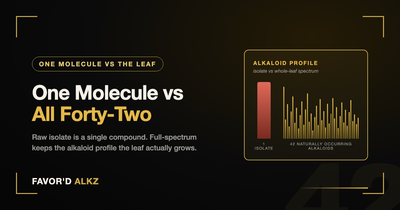
In natural kratom leaf, 7-OH is a minor alkaloid — generally less than 2% of total alkaloid content, according to a 2025 review by Alsbrook and colleagues in Pharmaceutical Biology and to the FDA. The 7-OH sold as a standalone product on the U.S. market is mostly a different animal: that review describes commercial 7-OH products as "chemically enriched or semi-synthetic, generated by oxidation of mitragynine isolates," delivering amounts far beyond anything the leaf produces on its own.
Why does that matter? Because 7-OH is substantially more potent at the mu-opioid receptor than mitragynine, kratom's dominant alkaloid. The figures cited in the literature are notable: an often-referenced guinea-pig ileum assay reported roughly 13 times the potency of morphine, and the Alsbrook review reports that 7-OH displays "ten- to twentyfold higher" mu-opioid-receptor binding affinity than mitragynine. Those numbers come largely from in-vitro and animal assays, not human dosing studies, and should be read as mechanistic signals rather than clinical conversion rates. But the direction is unambiguous — and it is a quantitative fact that podcast conversations almost never put on the table.
There is one more piece of pharmacology that the "it's just a leaf" framing skips: 7-OH is also an active metabolite of mitragynine. The body converts some ingested mitragynine into 7-OH through hepatic oxidation, as reported in ACS Central Science in 2019 by Kruegel and colleagues and in subsequent work. So even the leaf is not a story about a single gentle molecule — and a concentrated 7-OH product is something else again. Animal research reinforces the split: studies report that mitragynine shows limited abuse liability, while 7-OH demonstrates abuse liability, tolerance, cross-tolerance to morphine, and physical dependence on repeated administration. No honest reading of that supports a blanket "kratom is harmless" takeaway.
The timeline is the whole point
This is where the chronology becomes the spine of the story. The Rogan episodes that planted "kratom" in the popular imagination aired in the 2016–2018 window, when the conversation was largely about traditional leaf. The high-potency, semisynthetic 7-OH products that drew federal scrutiny became prominent later. A framing built for a leaf did not survive contact with a concentrate.
By 2025, the U.S. regulatory posture had sharpened. The FDA announced steps to restrict concentrated 7-OH products and recommended that the DEA schedule 7-OH under the Controlled Substances Act. In a July 2025 press conference, FDA Commissioner Marty Makary did not hedge on the chemistry:
"It binds to the mu receptor, which means scientifically, by definition, it is an opioid."
Makary described 7-OH as a concentrated byproduct of kratom sold in smoke shops and gas stations, and the agency issued warning letters to seven firms in mid-2025. The FDA's position is that 7-OH is not lawful in dietary supplements or foods, that no FDA-approved drug contains it, and that 7-OH products "have not been proven safe or effective for any use." The agency's consumer guidance lists harmful effects reported with these products — including addiction, anxiety, depression, gastrointestinal distress, insomnia, seizures, and withdrawal symptoms.
Crucially — and this is a place where it would be easy to overstate in either direction — the FDA framed this action as targeting concentrated, enriched 7-OH products, not natural kratom leaf. The agency has not banned all kratom, nor has it cleared 7-OH. It drew a line precisely along the leaf-versus-concentrate seam that the podcast conversation never named. And it did so while continuing to acknowledge how much remains unknown about kratom scientifically. The uncertainty runs both ways, and intellectual honesty requires saying so.
Why a microphone moves the needle
Step back from the chemistry and the real subject comes into focus: how plant substances get talked about, and why a host's casual aside can outrun the evidence. The reach here is not hypothetical. Pew Research Center found that 54% of U.S. adults listened to a podcast in the past 12 months, and about 32% get news from podcasts at least sometimes (10% often). Among people who hear news on the podcasts they listen to, trust runs high: in 2023, 87% expected that news to be mostly accurate, and most trusted it about as much as, or more than, other sources. A single trusted voice's offhand claim can therefore reach an audience the size of a small nation.
Health information, specifically, flows through these channels with strikingly weak verification. Pew found that 40% of U.S. adults ever get health or wellness information from social-media influencers or podcasts — yet only 10% of those consumers trust all or most of what they hear, with 65% trusting "some" and 24% trusting little or none. Separately, only 7% of Americans who get health information from social media rate that information as highly accurate, and many report difficulty judging the accuracy of health information at all. That gap — enormous reach, shaky verification, ambient distrust that somehow coexists with viral influence — is exactly the space where a confident monologue substitutes for a citation.
The honest verdict
So: what did Joe Rogan get right about kratom, and what did he miss? He and his guests got the mechanism roughly right — dose-dependent effects, activity at the opioid receptor — and they were right that the plant was understudied and that prohibition-by-reflex was premature. Those were not small things to say in 2016.
What the conversation missed, or under-weighted, was nearly everything that turned out to matter most: the chemical gulf between traditional leaf and concentrated 7-OH; the specific, escalating risks the FDA later attached to enriched 7-OH products; the active-metabolite pharmacology that complicates the "gentle leaf" picture; the dependence and withdrawal reality that clinicians now describe; and the hard limit of anecdote. "Natural," "I tried it and I'm fine," and "it's basically a coffee thing" are not evidence. They are vibes, and vibes scaled to millions of listeners can quietly rewrite what a culture believes it knows.
For anyone trying to make sense of 7-OH specifically, the responsible framing is the unglamorous one. It is a potent, concentrated, kratom-derived compound, chemically and pharmacologically distinct from leaf; its safety profile is still under study; the FDA has raised concerns about it specifically and recommended scheduling; its legality varies by state; and it is intended only for adults 21 and older. The single point worth making about the industry itself is one of accountability rather than benefit: a recurring problem regulators flag is mislabeled, undisclosed 7-OH content, which is precisely why responsible operators publish third-party lab COAs and treat testing transparency as a baseline business practice. That is a statement about honesty in labeling, not a claim about what any product does.
The deeper takeaway is not about any one host or any one molecule. It is that a microphone is not a method. The best thing the Rogan-era conversation did was ask for more research instead of more handcuffs. The worst thing it did was make a complicated, evolving, still-uncertain pharmacology sound settled — and "settled" is the one thing this story has never been.
Sources
- #876 - Chris Bell — The Joe Rogan Experience (Podchaser)
- #1136 - Hamilton Morris — The Joe Rogan Experience (Podchaser)
- Ep. 27: Joe Rogan on Kratom: Getting the Facts Straight — Dr. Suzette Glasner (UCLA)
- Site selective C–H functionalization of Mitragyna alkaloids reveals a molecular switch for tuning opioid receptor signaling efficacy — Nature Communications, 2021
- 7-Hydroxymitragynine Is an Active Metabolite of Mitragynine — ACS Central Science, 2019 (Kruegel et al.)
- From kratom to 7-hydroxymitragynine: evolution of a natural remedy into a public-health threat — Alsbrook et al., Pharmaceutical Biology, 2025 (PMC/NCBI)
- FDA Takes Steps to Restrict 7-OH Opioid Products Threatening American Consumers — U.S. FDA, 2025
- Products Containing 7-OH Can Cause Serious Harm — FDA Consumer Update, 2025
- 7-Hydroxymitragynine (7-OH): An Assessment of the Scientific Data and Toxicological Concerns — U.S. FDA
- 7-Hydroxymitragynine — Wikipedia (with cited primary sources)
- WHO Panel Finds Insufficient Evidence to Review Kratom — Pain News Network, Dec 8, 2021
- Podcasts and News Fact Sheet — Pew Research Center
- Americans' Experience With News on Podcasts — Pew Research Center, April 18, 2023
- Trust in Health and Wellness Influencers — Pew Research Center, May 7, 2026
- Where Do Americans Get Health Information, and What Do They Trust? — Pew Research Center, April 7, 2026
These statements have not been evaluated by the Food and Drug Administration. This article is for educational purposes only and is not medical advice; nothing here is intended to diagnose, treat, cure, or prevent any disease. Products discussed are intended for adults 21 and older. Laws governing kratom and 7-hydroxymitragynine vary by state and locality — check your local regulations before purchasing.
Research & sources: kratom leaf chemistry and 7-OH facts in this article are drawn from peer-reviewed literature and primary regulatory sources.
- Takayama (2004), Chem. Pharm. Bull. — alkaloid profile of Mitragyna speciosa; 7-OH ≈2% of the alkaloid fraction
- Flores-Bocanegra et al. (2020), J. Nat. Prod. — at least 54 alkaloids identified in kratom leaf
- FDA — 7-hydroxymitragynine — the federal view of natural vs concentrated 7-OH
- Favor'd Alkz Regulation Map — current state-by-state shipping status
Shop The New Lineup
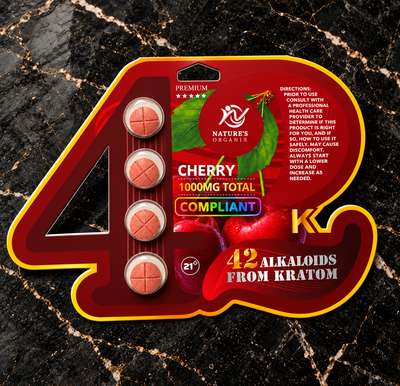
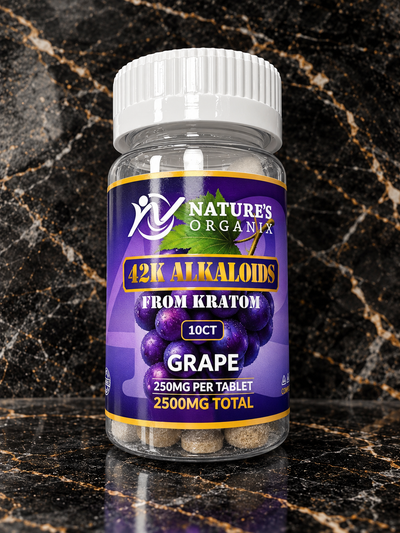
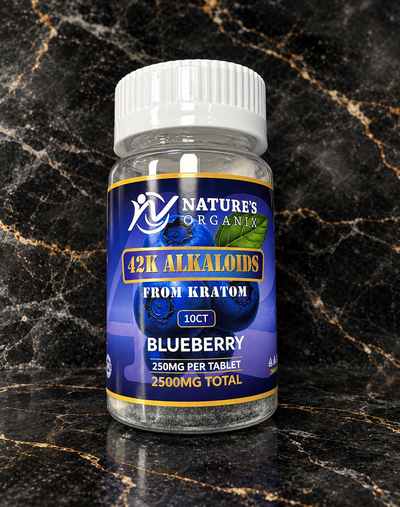
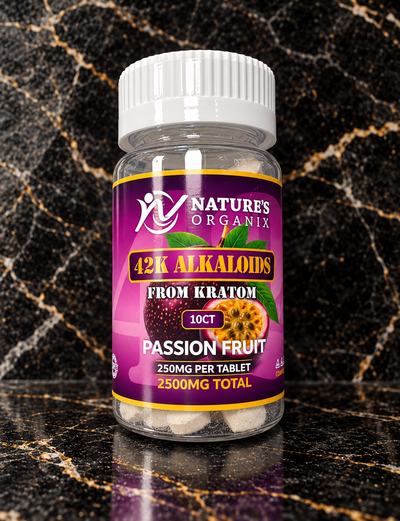
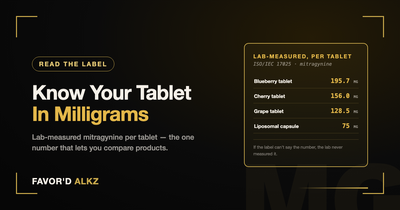
Full-spectrum, naturally derived kratom tablets and liposomal capsules — every alkaloid as the leaf made it, including naturally occurring 7-OH. Lab-tested ISO/IEC 17025; the capsule COA is published and all other certificates are available on request.
Kratom Tablets · 7-OH Ban Timeline · Lab Results
Keep Reading