
Scroll through enough wellness content and you will run into a worldview disguised as a hashtag: natural good, synthetic bad. It is a tidy story. Plants are wholesome; laboratories are suspect. A long Latin name on an ingredient list reads as a warning, while "found in nature" reads as a blessing.
The trouble is that this instinct, however emotionally satisfying, is not chemistry. It is a logical error with a name — the appeal-to-nature, or naturalistic, fallacy — and once you understand why it fails, a lot of internet health discourse stops making sense.
This is not an argument that everything synthetic is fine, or that "natural" products are inherently dangerous. It is an argument that the word natural tells you almost nothing about whether a compound is safe, and that treating it as a safety certificate leads people badly astray. That matters everywhere from your kitchen cabinet to the most contested products on the market today.
The fallacy, stated plainly
The chemistry-education project Compound Interest put the core point about as clearly as it can be put: "whether a chemical is natural or man-made tells us nothing about its toxicity." There are, the same explainer notes, "many chemical compounds, found naturally in plants, that are poisonous to humans in small amounts." Origin is not a property that travels with a molecule into your bloodstream. The body does not check a compound's birth certificate.
If origin doesn't determine harm, what does? Dose. The foundational principle of toxicology is nearly five centuries old, traceable to the physician Paracelsus. A 2018 review in Toxicology Reports renders his maxim this way:
"All things are poison and nothing is without poison, only the dose permits something not to be poison."
Water, oxygen, table salt, caffeine — all are toxic at some dose and harmless at another. Toxicity is a function of how much, not of where it came from. That single sentence dismantles the natural-versus-synthetic binary on its own.
A molecule doesn't know where it was born
Here is the part the binary truly cannot survive. A compound is defined by its chemical structure, not its provenance. Vitamin C isolated from an orange and vitamin C made in a reactor are the same molecule, and they behave identically in the body.
"Natural" and "synthetic" versions of an identical structure are chemically indistinguishable — not similar, not comparable, but the same thing. To prefer one over the other on the grounds of origin is to prefer a label, not a substance.
And if you still suspect that nature trends gentle, consider that some of the most dangerous substances known are entirely natural. Botulinum toxin, produced by bacteria, is among the most toxic compounds on Earth. It is as natural as sunlight, and a vanishingly small amount can kill. Nature is not a careful pharmacist; it is an indifferent chemist that produces poisons and nutrients with equal ease.
The plant kingdom's pharmacy of poisons
Plants are the clearest case study. The StatPearls reference "Plant Alkaloids Toxicity," hosted on NCBI Bookshelf and updated in 2023, describes plant alkaloids as "secondary plant metabolites found ubiquitously in nature" that "represent the toxic components of many of the well-known poisonous plants," with humans and animals able to "experience noxious consequences." The roster is sobering and entirely botanical: atropine from Datura (jimsonweed), nicotine, strychnine, and the coniine of poison hemlock (Conium maculatum), the alkaloid the same reference calls the "killer of Socrates." Every one of these is "natural." None is safe.
The point extends to the herbal-remedy aisle, where "traditional" and "natural" are often used as proof of gentleness. They are not. Aristolochic acid, produced by Aristolochia plants and used for centuries in herbal preparations, is classified by the International Agency for Research on Cancer as a Group 1 human carcinogen and is associated with kidney failure and urothelial cancer, as documented in a 2014 review in BioMed Research International. A plant medicine, used in good faith for generations, turned out to be a potent carcinogen. "Natural" did not protect anyone.
What extraction, isolation, and semi-synthesis actually do
If the natural/synthetic line is mostly noise, the words that do carry information are the ones describing what was done to a compound. Three are worth knowing.
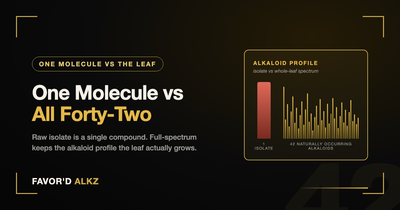
Extraction and isolation are about concentration and purity. You start with a plant and pull out one specific compound, then concentrate it. This is the step the wellness internet most often misreads, because the resulting isolate is not the same thing as the source material consumed traditionally.
Concentrating a minor constituent of a plant can produce something with a dramatically different exposure profile than the whole plant ever delivered. The leaf and the isolate may share a molecule and share nothing else that matters.
Semi-synthesis means taking a natural starting material and chemically modifying it to change its properties. A 2021 Nature Reviews Drug Discovery survey of natural products explains the rationale bluntly: "unmodified NPs may possess suboptimal efficacy or absorption, distribution, metabolism, excretion and toxicity (ADMET) properties," so "chemical modification may be required," using a natural product "as a starting point for the introduction of chemical modifications." In other words, scientists often change nature's version precisely because the original is too harsh, too unstable, or too poorly absorbed.
When the lab-made version is the gentler one
Aspirin is the textbook example, and it neatly inverts the folk wisdom. Willow bark — about as "natural" a remedy as exists — contains salicin, which the body converts to salicylic acid. According to McGill University's Office for Science and Society, the salicylates in use before aspirin had a bitter taste and "often caused stomach irritation." Chemists acetylated salicylic acid to produce acetylsalicylic acid, better known as aspirin, a molecule that, as McGill notes, "does not occur in nature" and "came about as an improvement on the natural salicylates." Here the synthetic compound was the more tolerable one. The willow-bark purist is choosing the rougher option.
Semi-synthesis can also be the more sustainable choice. The cancer drug paclitaxel (Taxol) was first isolated from the bark of the Pacific yew, but harvesting it is ruinous: a 2024 paper in the European Journal of Medical Research reports that "it takes 2000–2500 yew trees to produce just one kilogram of taxol." Producing it instead by semi-synthesis from a renewable precursor, 10-deacetylbaccatin III, lets manufacturers make taxanes "without adversely hurting the trees." Sometimes the laboratory route is the one that spares the forest.
Where the word "natural" does the most misleading work
All of this is more than an abstract chemistry lesson, because the single most contested category in this space right now is concentrated plant derivatives — and there the natural-equals-safe reflex is doing a great deal of heavy lifting.
Consider 7-hydroxymitragynine, or 7-OH, a compound associated with the kratom plant. It is frequently marketed under a "natural" halo, and on a narrow technicality the word applies: 7-OH does occur in the kratom leaf. But it occurs there only in trace amounts. As the U.S. Food and Drug Administration explains in a consumer update, while 7-OH occurs naturally in trace amounts in the plant kratom, the agency's warning is directed at products containing 7-OH as an added ingredient or at enhanced levels.
That distinction is the whole essay in miniature: a trace constituent of a leaf and a product built around concentrated or added 7-OH are not the same proposition, even though both can reach for the word natural.
The agency itself draws the line between the leaf and the derivative. In a July 29, 2025 press announcement, the FDA said it "is specifically targeting 7-OH, a concentrated byproduct of the kratom plant; it is not focused on natural kratom leaf products," and FDA Commissioner Marty Makary stated that "7-OH is an opioid that can be more potent than morphine." The agency recommended a scheduling action for certain 7-OH products under the Controlled Substances Act, a recommendation the Drug Enforcement Administration is reviewing.
Whatever one makes of that regulatory posture, note the structure of the argument: the FDA is treating the concentrated derivative as a different thing from the leaf — the same distinction between source material and isolate that runs through this entire piece.
The FDA is "specifically targeting 7-OH, a concentrated byproduct of the kratom plant; it is not focused on natural kratom leaf products."
To be plain about the current landscape: 7-OH is a potent, concentrated kratom-derived compound that is chemically and pharmacologically distinct from traditional leaf, and its safety profile remains under study and openly contested. The FDA has characterized it as an opioid with potential for abuse, and per the agency there are no FDA-approved 7-OH drugs, 7-OH is not lawful in dietary supplements, and 7-OH cannot be lawfully added to conventional foods; the FDA states that such products have not been proven safe or effective for any use.
In early December 2025, the FDA and the Department of Justice announced the seizure of roughly 73,000 units of concentrated 7-OH products, valued near $1 million, from firms in Missouri. Legality varies by state and locality, and these products are restricted to adults 21 and older. None of that is a verdict on 7-OH in either direction; it is the reason the "natural" framing cannot be allowed to do the arguing.
The crucial inference is the one the chemistry forbids you from making: that because 7-OH "occurs in nature," it must therefore be safe, benign, or unregulated. That inference is invalid — that is the entire point of this article. Natural origin is not an argument for the safety or the legality of any concentrated derivative. It is, at most, a fact about a molecule's family tree.
Read the molecule, not the marketing
So what should replace the natural/synthetic shortcut? Four questions, each evaluated on its own rather than assumed from a word: What is the actual compound? At what concentration or dose? What does the evidence base actually say? And what is its legal and regulatory status? Origin is not on that list, because origin is not load-bearing.
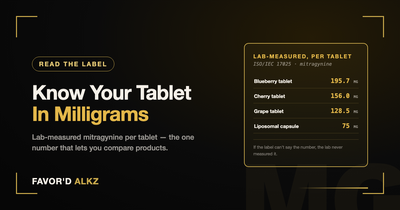
This is also why transparency about what is in a product matters as a basic business practice. Favor'd Alkz publishes third-party lab certificates of analysis (COAs) so that buyers can see what a given product actually contains — not as any claim about safety or benefit, but because the only honest starting point for any of the four questions above is knowing the compound and its concentration in the first place.
"Natural" is a marketing word, not a safety certification. Hemlock is natural. Botulinum toxin is natural. Aspirin is not. A molecule behaves the way its structure dictates, in the amount you encounter it, regardless of whether it came from a plant, a bacterium, or a flask. The most scientifically literate thing you can do with the next "all-natural" post that scrolls past is to ask the question the word is designed to make you skip: natural — and so what?
Sources
- Natural vs. Man-Made Chemicals – Dispelling Misconceptions — Compound Interest (Andy Brunning)
- The dose response principle from philosophy to modern toxicology — Toxicology Reports (2018), via NCBI/PMC
- Plant Alkaloids Toxicity — StatPearls — StatPearls / NCBI Bookshelf (updated 2023)
- Chinese Herbs Containing Aristolochic Acid Associated with Renal Failure and Urothelial Carcinoma — BioMed Research International (2014), via NCBI/PMC
- Natural products in drug discovery: advances and opportunities — Nature Reviews Drug Discovery (2021), via NCBI/PMC
- Forget the Willow Bark Extract — Go For Aspirin — Office for Science and Society, McGill University (Joe Schwarcz, 2022)
- Paclitaxel and its semi-synthetic derivatives — European Journal of Medical Research (2024), via NCBI/PMC
- FDA Takes Steps to Restrict 7-OH Opioid Products Threatening American Consumers — U.S. Food and Drug Administration (July 29, 2025)
- Products Containing 7-OH Can Cause Serious Harm — U.S. Food and Drug Administration (Consumer Update)
- FDA Seizes 7-OH Opioids to Protect American Consumers — U.S. Food and Drug Administration (December 2, 2025)
Research & sources: kratom leaf chemistry and 7-OH facts in this article are drawn from peer-reviewed literature and primary regulatory sources.
- FDA — 7-hydroxymitragynine — the federal view of natural vs concentrated 7-OH
- Takayama (2004), Chem. Pharm. Bull. — alkaloid profile of Mitragyna speciosa; 7-OH ≈2% of the alkaloid fraction
- Flores-Bocanegra et al. (2020), J. Nat. Prod. — at least 54 alkaloids identified in kratom leaf
These statements have not been evaluated by the Food and Drug Administration. This article is for educational purposes only and is not medical advice; nothing here is intended to diagnose, treat, cure, or prevent any disease. Products discussed are intended for adults 21 and older. Laws governing kratom and 7-hydroxymitragynine vary by state and locality — check your local regulations before purchasing.
Shop The New Lineup
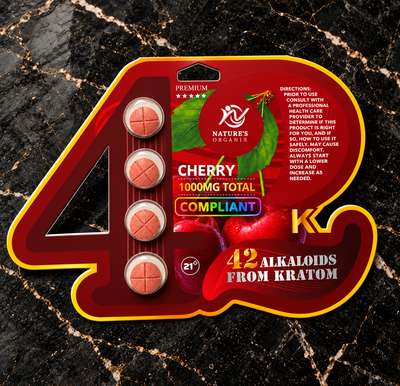
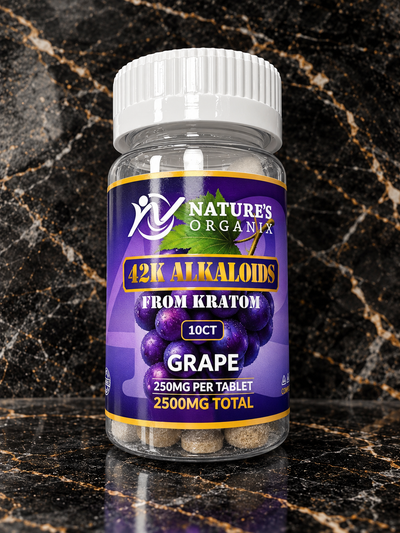
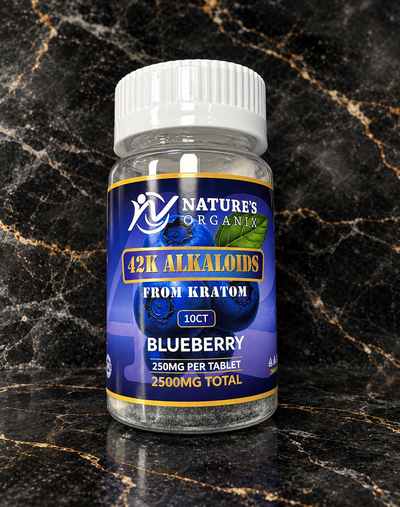
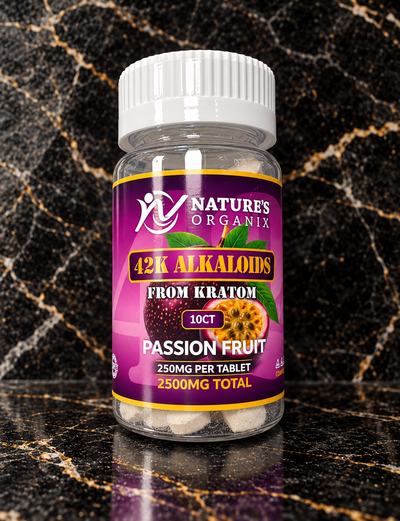
Full-spectrum, naturally derived kratom tablets and liposomal capsules — every alkaloid as the leaf made it, including naturally occurring 7-OH. Lab-tested ISO/IEC 17025; the capsule COA is published and all other certificates are available on request.
Kratom Tablets · 7-OH Ban Timeline · Lab Results
Keep Reading