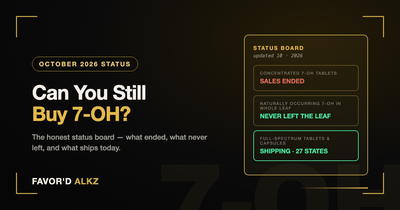

Status — Updated September 24, 2026
- Favor’d Alkz has ended all 7-OH sales. Our final 7-OH inventory sold through on September 24, 2026. We will not offer 7-OH products again unless the DEA’s final decision permits it.
- The DEA-1644 compounds (mitragynine pseudoindoxyl, MGM-15, MGM-16) were withdrawn from sale earlier, and our remaining stock was destroyed in late August 2026.
- DEA-1570 — the 7-OH threshold docket — is the decision we are watching; this page is updated as the record changes.
- Mitragynine itself and natural kratom leaf remain unscheduled federally.
- ISO/IEC 17025 COAs for past lots remain available on request.
- Now live: the full-spectrum lineup — naturally occurring 7-OH, lab-tested, state-compliant.
- Full dated history: 7-OH Ban Timeline & Status Tracker.
Original filing summary — August 4, 2026 (kept for the record)
- The DEA filed two Notices of Intent on July 1, 2026. Both were published in the Federal Register on July 6, 2026.
- DEA-1570 (FR Doc. 2026-13580) covers 7-OH above a threshold: more than 0.05% by dry weight, or more than 1.00 mg of 7-OH per article for a processed product.
- DEA-1644 (FR Doc. 2026-13581) separately names mitragynine pseudoindoxyl, MGM-15 and MGM-16. Those compounds are in scope, not exempt from it.
- Mitragynine itself and kratom leaf are not named in either notice.
- A temporary order cannot issue before August 5, 2026. The DEA has said it intends to act as soon as possible after that point. August 5 is the earliest possible date, not a guaranteed one.
- Temporary placement would run two years, extendable by one.
- Favor’d Alkz order cutoff for the 7-OH catalog: Wednesday, August 5, 3:33 PM PT. The USPS Overnight carrier handoff is 11:30 AM PT that day.
The 7-OH category shifted in early July 2026, and most of the search results on this topic are either sales pages pushing alternate alkaloids or recovery-site warnings. This page does something simpler: it maps what is inside the DEA threshold versus outside it, using only the figures the agency published, so you can see which product classes are affected and which are not.
What exactly did the DEA do in July 2026?
Status update — September 4, 2026: The analogues named in DEA-1644 — mitragynine pseudoindoxyl, MGM-15 and MGM-16 — are no longer sold by Favor’d ALKz, and those products have been withdrawn from sale. DEA-1570 concerns 7-OH and is a separate docket. Timeline statements elsewhere on this page describe the position as at the date they were written and may not reflect the current record. For current state-by-state status see our Kratom Regulation Map. Informational only; not legal advice.
The DEA filed a Notice of Intent on July 1, 2026 to temporarily place concentrated 7-hydroxymitragynine into Schedule I of the Controlled Substances Act. The notice was published in the Federal Register on July 6, 2026, which starts a 30-day waiting period before any temporary scheduling can take effect. Based on that publication date, the earliest effective date is roughly August 5, 2026. This is a factual timeline, not a prediction — the agency can act on or after that date, and dates can move.
What is actually covered by the scheduling action?
The action is written around a concentration threshold, not around kratom as a whole. Two figures define it:
- More than 1 mg of 7-OH per product, or
- More than 0.05% 7-OH by dry weight
It also names three synthetic derivatives specifically: mitragynine pseudoindoxyl (MP), MGM-15, and MGM-16. Those are lab-made compounds, distinct from what occurs naturally in the leaf.
What is NOT covered?
Per the notice as published, natural kratom leaf that sits below the 1 mg / 0.05% threshold is not part of the scheduling action. Mitragynine — the primary naturally occurring alkaloid in the leaf — is not itself the target here; the action is aimed at concentrated and enhanced 7-OH and the three synthetics above. This is the distinction that matters when people ask about "legal alternatives."
In vs. out: a quick reference
| Product class | Status under the July 2026 action | What to check |
|---|---|---|
| Concentrated / enhanced 7-OH (over 1 mg or over 0.05% by dry weight) | Named in the scheduling action | Label serving size and COA 7-OH content |
| Synthetic derivatives: MP, MGM-15, MGM-16 | Named in the scheduling action | Ingredient list; these are lab-made, not leaf-derived |
| Natural kratom leaf below the threshold | Not named in the scheduling action | COA showing 7-OH under 0.05% by dry weight; your state's law |
| Mitragynine-forward leaf products | Not named in the scheduling action | COA and label; state KCPA rules |
How do I tell which category a product falls into?
Two documents settle it: the product label and the Certificate of Analysis (COA). The label states the serving size and what the product is; the COA reports the measured 7-OH content, which is what the threshold is written against. We publish COAs for our catalog on the lab results page so you can read the numbers yourself rather than take a claim on faith. We do not offer dosing guidance — the label states serving size per label, and that is the only strength framing we give.
Does state law still matter?
Yes. Beyond the federal action, individual states set their own rules, many through the Kratom Consumer Protection Act (KCPA). State-law variance means a product class that is not federally scheduled can still be restricted where you live. Favor'd ALKz does not ship to restricted states, and orders are 21+ only. Always confirm your own state's current status before buying.
So which products fall outside the threshold?
The practical takeaway: the product classes that fall outside the named threshold are natural leaf-based options — subject to your state's law and to whatever the DEA finalizes. If you're browsing, our powder collection and tablet collection each list serving size per label and link to their COAs. We are not claiming any product will remain legal indefinitely; we are pointing you to the label and COA so you can match a product to the threshold figures above and decide for yourself.
MGM-15 and pseudoindoxyl are named too — they are not a “legal 7-OH alternative”
Some products in this category are currently marketed as legal alternatives to 7-OH on the strength of containing MGM-15. That framing is inconsistent with the published record. The second Notice of Intent, DEA-1644 (FR Doc. 2026-13581), names mitragynine pseudoindoxyl, MGM-15 and MGM-16 for temporary Schedule I placement on the same timeline as concentrated 7-OH under DEA-1570.
We state this plainly because we previously sold pseudoindoxyl and MGM-15 products ourselves, and our own customers are owed the same disclosure: those two classes are named in DEA-1644 and sit under the same August 5 earliest-effective-date timeline as our 7-OH catalog. Per-lot certificates for what we shipped are archived on our lab results page.
Which product class is not named in either notice?
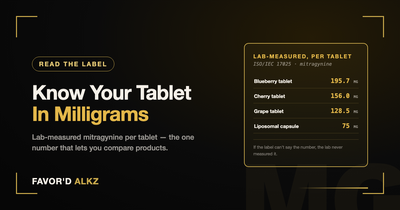
Mitragynine. Neither DEA-1570 nor DEA-1644 names mitragynine or kratom leaf. Our Watermelon MIT Tablets are a pressed mitragynine tablet: the PharmLabs San Diego certificate (ISO/IEC 17025 Acc. 85368, sample SD260729-018) reports 128.66 mg of mitragynine per serving, with 7-OH and MGM-15 reported as Not Detected. On the face of that certificate, the product does not fall within either scheduled class. The rest of that line is on the mitragynine tablets collection page.
To be precise about what we are and are not saying: we are describing what the Federal Register notices contain and what the certificate of analysis reports. We are not telling you any product is legal, and we are not predicting that anything will stay that way. State law applies independently of the federal record, and the federal record can change. Adults 21+ only.
Frequently asked questions
Is all 7-OH becoming illegal in 2026?
No. The July 2026 action is written around concentrated 7-OH — over 1 mg per product or over 0.05% by dry weight — plus three named synthetics (MP, MGM-15, MGM-16). Natural leaf below that threshold is not named in the action.
When would the scheduling take effect?
The notice published in the Federal Register on July 6, 2026, triggering a 30-day waiting period. That puts the earliest possible effective date at roughly August 5, 2026. Temporary scheduling can occur on or after that point.
What are MP, MGM-15, and MGM-16?
They are synthetic derivatives — lab-made compounds named specifically in the scheduling action, separate from the naturally occurring alkaloids in kratom leaf.
How do I verify a product's 7-OH content?
Check the Certificate of Analysis — it reports measured 7-OH content, the figure the DEA threshold is written against. Our current capsule COA is published on the lab results page, and archived certificates for the retired 7-OH catalog are available on request by email.
Will my state allow it?
That depends on your state. Many states regulate through the Kratom Consumer Protection Act, and rules vary. We do not ship to restricted states, and all orders are 21+.
Research & sources: kratom leaf chemistry and 7-OH facts in this article are drawn from peer-reviewed literature and primary regulatory sources.
- FDA — 7-hydroxymitragynine — the federal view of natural vs concentrated 7-OH
- Takayama (2004), Chem. Pharm. Bull. — alkaloid profile of Mitragyna speciosa; 7-OH ≈2% of the alkaloid fraction
- Favor'd Alkz Regulation Map — current state-by-state shipping status
These statements have not been evaluated by the FDA. This product is not intended to diagnose, treat, cure, or prevent any disease. For adults 21+.