
The myth an addiction documentary sells is that one person's ruin, filmed closely enough, tells you what a substance does to everyone. It doesn't. What the genre actually runs on is a formula: a person, often photogenic and articulate; a substance, introduced like a character with a motive; a descent, a crisis, and either a redemption or a funeral. The form is not lying, exactly. It is doing what narrative does: compressing a sprawling, statistical, deeply confounded reality into a story a viewer can hold in one hand. The trouble starts when we mistake that compression for evidence.
Kratom has become a recurring guest in this genre, and it makes for an awkward fit. It is a botanical with messy, contested pharmacology; its risks are real but hard to isolate; and its most concentrated derivatives are chemically distinct from the leaf in ways that surveillance data often cannot even register. That is precisely the kind of nuance a villain arc cannot accommodate. This essay is not a defense of kratom or a claim that it is harmless — the scientific literature is explicit that physical dependence is real. It is an argument about how media frames substances, and what a media-literate viewer should ask before accepting a documentary's verdict.
The Genre Has a House Style
Researchers have started cataloguing that house style. A 2025 scoping review in Cult Sci, “Analysing media portrayals of people with substance use disorder and addiction,” found that media depictions “continue to reinforce negative stereotypes.” When the authors coded coverage, the recurring frames were strikingly consistent: portrayals as violent or dangerous (43.8% of the articles examined), as criminal (37.5%), and as engaged in risky behaviours (37.5%). The review also documented dehumanizing language and a racial double standard — coverage that tended, in its words, to “humanize White drug-users while associating Black and Latino drug-users with criminality and violence.”
These are narrative archetypes, not findings. They are the grammar of how addiction gets told on screen. And they reveal the documentary's actual optimization target: emotional coherence. A clean arc requires a clean cause. That structural need is exactly where accuracy tends to break.
The Yardstick: What Responsible Coverage Looks Like
To say a documentary is imprecise, you need a standard of precision. Science journalists have written one down. In “Covering Substance Use and Addiction Responsibly,” published by The Open Notebook in 2023, Rachel Crowell lays out the craft norms: avoid stigmatizing clichés, remember that “all scientific studies, including those centered on substance use and addiction, have limitations,” and verify claims rather than amplify them.
That last point comes with a vivid example. The guide flatly debunks a viral myth — “No, police officers aren't overdosing by touching fentanyl” — to illustrate how a dramatic, sharable story can be simply false. It also urges reporters to treat people with lived experience as “subject experts in their own community and their own experiences.” Measured against this yardstick, the gap is not that documentaries lie. It is that they rarely flag their own limitations, and they reach for the cliché because the cliché is cinematic.
The Core Error: Presence Is Not Proof
If there is one media-literacy lesson that kratom coverage demands, it is the difference between detection and causation. A documentary loves a toxicology report. A substance shows up in a postmortem screen, and the screen becomes the verdict. But presence in a body is exposure, not cause.
A 2024 commentary in Frontiers in Psychiatry, examining kratom in opioid-overdose death reports, makes the point with forensic care:
“No causative lethal blood concentration, nor a lethal dose for kratom, mitragynine, or other alkaloids, has been established in humans or animals.”
And the consequence for how deaths get attributed:
“A death attributed to polydrug exposure may erroneously include kratom as a contributory but not causative agent, even if other substances are present in concentrations consistent with subtherapeutic, therapeutic, or overdose use.”
This is the exact leap dramatized storytelling invites: a hit on a screen, narrated as the agent of death. The literature insists you have to establish causation first — and in many of these cases, the tools to do so do not yet exist.
The Polysubstance Reality the Camera Flattens
Single-substance stories are easier to tell. Real harm is rarely so tidy. In March 2026, the CDC's Morbidity and Mortality Weekly Report published “Increases in Kratom-Related Reports to Poison Centers,” analyzing National Poison Data System figures and noting that kratom-related exposure reports rose roughly 1,200% from 2015 to 2025. Buried in the data is a fact a clean arc cannot survive: among kratom-associated deaths, 184 of 233 — 79% — “involved multiple substances,” with opioids reported in 62% of fatalities.
The pattern holds for non-fatal harm too. The honest framing is not that kratom “rarely kills.” It is that attribution in a polysubstance context is genuinely hard — and a documentary that isolates one substance from the chemical crowd it was found in is performing a magic trick, not an analysis.
The Distinction the Data Cannot See
Here the same CDC report delivers its most disciplined caveat. It cautions that “the data do not include information about whether the kratom use involved traditional leaf products or semisynthetic or concentrated formulations, such as 7-hydroxymitragynine, thereby limiting conclusions about formulation-specific risks.”
Read that twice. Even the surveillance system cannot reliably distinguish a traditional leaf preparation from a concentrated, semisynthetic compound. Yet documentaries routinely treat “kratom” as one monolithic thing — a single named villain — when the underlying category spans products that differ enormously in potency and chemistry. When the data themselves blur that line, a film that erases it is not simplifying. It is misrepresenting.
“Kratom Is an Opioid” Is a Shorthand, Not a Fact
The most common framing device is the equals sign: kratom is an opioid. It is rhetorically efficient and pharmacologically incomplete. A 2024 Frontiers in Pharmacology review, “Kratom safety and toxicology in the public health context,” argues that while kratom is popularly cast as an opioid, it “is more accurately characterized as a substance with diverse and complex pharmacology.” The review describes mitragynine's activity this way:
“Mitragynine has a complex pharmacology including partial agonism at the µ-opioid receptor, antagonism at the κ-opioid receptor and agonism at adrenergic, serotonergic, D2-dopaminergic and adenosine receptors.”
Partial agonism here, antagonism there, plus four other receptor systems. None of that fits in a chyron. The shorthand “opioid” collapses a multidimensional pharmacology into a one-word category — convenient for narration, lossy as science.
Dependence Is Real. Do Not Let Anyone Tell You Otherwise.
A media critique can curdle into apologetics if it is not careful, so let me be unambiguous: physical dependence and withdrawal are real. The expert-forum paper “Kratom withdrawal,” published in Drug and Alcohol Dependence Reports in 2023, confirms that withdrawal “only occurs following high mitragynine intake” — but it does occur. That is not in dispute, and any framing that waves it away is its own kind of distortion.
The same paper is where evidence-quality literacy gets interesting. It reports that kratom withdrawal symptoms are “generally milder than observed with chronic frequent opioid, sedative, or stimulant users,” and that in two controlled studies using validated scales, “there were no significant differences between placebo or any of the kratom dosing conditions in SOWS and COWS scores.” This is reported here as a comment on the state of the evidence, not as guidance about using anything.
Then the authors do the thing documentaries almost never do — they flag their own limits, noting that the online surveys behind much of this work “are convenience samples of self-selected respondents” with limited generalizability. That dual move is the whole lesson: dependence is real and the evidence on its severity is variable and incomplete. Both clauses are true at once. A villain arc can hold only the first; honest inquiry has to hold both.
How a Single Story Becomes a Category
Put the pieces together and you can see the mechanism. The genre selects the most dramatic individual — the n-of-1 — because that is what moves an audience (the scoping review's archetypes at work). It presents a toxicology hit or a relapse as causal proof (the leap the Frontiers in Psychiatry commentary warns against). And it generalizes from that one case to an entire substance, flattening the polysubstance context and the leaf-versus-concentrate distinction the CDC says the data cannot even resolve. Each step is reasonable as storytelling. Stacked together, they manufacture a certainty the science explicitly disclaims.
A Media-Literate Checklist
So watch the next documentary with four questions ready:
- Causation or correlation? Is the substance shown to have caused the harm, or merely detected near it?
- Which product? Traditional leaf and concentrated, semisynthetic compounds are not interchangeable — and surveillance data often can't tell them apart.
- What's the sample? One vivid person is not a population. Convenience samples are not controlled trials.
- Who's missing? Whose lived experience and which inconvenient data got left on the cutting-room floor?
Where Honesty Demands We Stop
This is the point where a brand in this space is tempted to declare victory and imply the substance is safe. It is not that simple, and pretending otherwise would repeat the very sin this essay diagnoses.
Consider 7-hydroxymitragynine, or 7-OH. It is a potent, concentrated, kratom-derived compound — pharmacologically and chemically distinct from the trace amounts found in natural leaf. Its safety profile remains under study, and the U.S. Food and Drug Administration has publicly raised concerns about 7-OH specifically. Its legality varies by state and locality, and products are for adults 21 and older. None of that is a reason to dramatize it falsely, and none of it makes 7-OH a “solution” to anything a documentary depicts — it isn't, and nothing here should be read as suggesting it is. The critique here is of media calibration, not a verdict that any of these compounds is benign. Real dependence exists. Genuine safety questions are open. Both things can be true while the documentary's causal certainty remains unearned.
If there is a quiet through-line, it is the value of being able to see what is actually in a product rather than treating it as an unlabeled mystery. As a business practice — not a health claim — Favor'd Alkz publishes third-party lab certificates of analysis (COAs) so that what is inside a product is documented and visible. That is transparency about contents, nothing more. The science is still being written; the responsible move is to read it carefully, hold its uncertainty honestly, and refuse the tidy arc in either direction.
Sources
- Analysing media portrayals of people with substance use disorder and addiction: A scoping review — Cult Sci (PMC/NCBI), 2025
- Covering Substance Use and Addiction Responsibly — The Open Notebook (Rachel Crowell, 2023)
- Commentary: Presence of kratom in opioid overdose deaths — Frontiers in Psychiatry (PMC/NCBI), 2024
- Increases in Kratom-Related Reports to Poison Centers — National Poison Data System, United States, 2015–2025 — CDC MMWR, March 2026
- Kratom safety and toxicology in the public health context — Frontiers in Pharmacology, June 2024
- Kratom withdrawal: Discussions and conclusions of a scientific expert forum — Drug and Alcohol Dependence Reports (PMC/NCBI), 2023
These statements have not been evaluated by the Food and Drug Administration. This article is for educational purposes only and is not medical advice; nothing here is intended to diagnose, treat, cure, or prevent any disease. Products discussed are intended for adults 21 and older. Laws governing kratom and 7-hydroxymitragynine vary by state and locality — check your local regulations before purchasing.
Research & sources: kratom leaf chemistry and 7-OH facts in this article are drawn from peer-reviewed literature and primary regulatory sources.
- FDA — 7-hydroxymitragynine — the federal view of natural vs concentrated 7-OH
- Flores-Bocanegra et al. (2020), J. Nat. Prod. — at least 54 alkaloids identified in kratom leaf
- Favor'd Alkz Regulation Map — current state-by-state shipping status
Shop The New Lineup
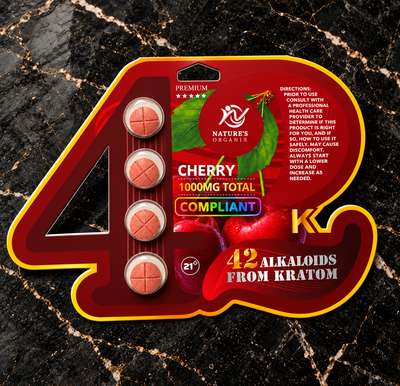
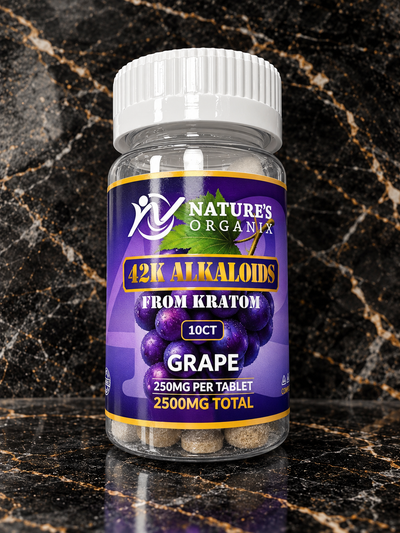
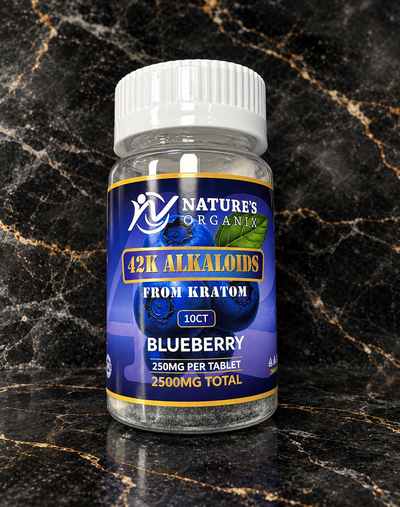
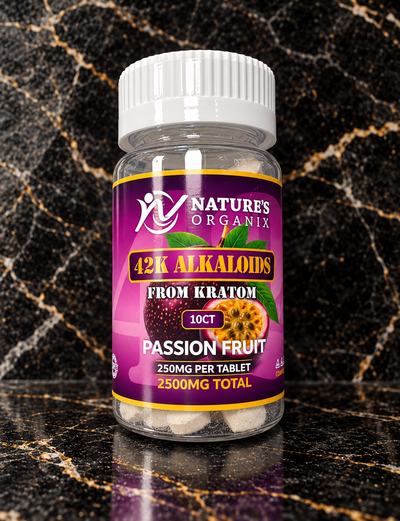
Full-spectrum, naturally derived kratom tablets and liposomal capsules — every alkaloid as the leaf made it, including naturally occurring 7-OH. Lab-tested ISO/IEC 17025; the capsule COA is published and all other certificates are available on request.
Kratom Tablets · 7-OH Ban Timeline · Lab Results
Keep Reading