
Quick Answer
Kratom (Mitragyna speciosa), a Southeast Asian tree in the coffee family, has been used for centuries — its leaves chewed fresh or brewed as tea. The plant contains dozens of alkaloids, including 7-hydroxymitragynine (7-OH). This is the botanical, chemical, and regulatory history of how a traditional leaf became a concentrated compound at the center of U.S. policy debate.
Somewhere in the humid lowlands of mainland Southeast Asia, long before any laboratory existed to name its compounds, a tree in the coffee family was already part of daily working life. People in what are now Thailand, Malaysia, and Indonesia chewed its glossy leaves fresh or steeped them into a tea. The tree was Mitragyna speciosa — the plant the world would later call kratom.
The story of kratom is, in many ways, about distance — between a leaf chewed in a rice paddy and a flavored “shot” sold online; between a plant with dozens of naturally occurring compounds and a single, concentrated molecule now at the center of an American regulatory fight. To understand why 7-hydroxymitragynine (7-OH) has become a flashpoint, you have to start with the tree itself.
The Tree and Its Leaf
Kratom is the common name for Mitragyna speciosa, a large tropical evergreen in the Rubiaceae family — the same botanical family as coffee. According to Encyclopaedia Britannica, the tree is native to Southeast Asia, ranging across Thailand, Malaysia, Indonesia, and neighboring areas, with mature specimens reaching roughly 50 feet tall.
Its leaves have been used in the region for generations. The World Health Organization’s Expert Committee on Drug Dependence (ECDD) and the NIH-published StatPearls reference both describe a long tradition of use among rural laborers in Southeast Asia — a description of historical and cultural practice, not a present-day claim about what kratom does for anyone.
A Chemically Crowded Leaf
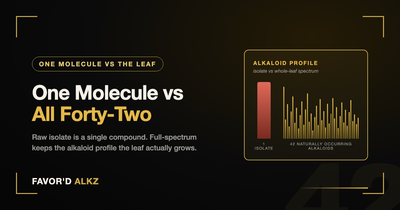
Part of what makes kratom scientifically interesting — and hard to reduce to a single headline — is that the leaf is chemically complex: not one compound but a crowd of them. A 2025 review in Pharmaceutical Biology reports the leaf contains “more than 40 identified” alkaloids to date, including mitragynine, 7-hydroxymitragynine, speciociliatine, paynantheine, speciogynine, and corynantheidine. More recent phytochemical work puts the count at at least 54 identified alkaloids (Flores-Bocanegra et al., 2020).
The dominant member of that crowd is mitragynine. The 2025 Pharmaceutical Biology review reports that it “typically compris[es] 12–66% of the total alkaloid content” depending on geography, harvest, and processing. When people historically chewed or brewed the leaf, mitragynine was the molecule they were primarily consuming.
7-OH: A Trace Compound, Not a Headline Ingredient
This is where the most important — and most often misunderstood — fact of the story lives. In the raw plant, 7-hydroxymitragynine is only a minor, trace alkaloid. The 2025 review is blunt: 7-OH “generally constitutes <2% of the total alkaloid content,” is “not measurable in fresh leaves,” and spans roughly 0.011–0.039% by weight in dried preparations. That tracks with Takayama’s 2004 alkaloid profiling, which reported 7-OH at roughly 2% or less of the alkaloid fraction in Thai leaf material. In other words, the compound now driving so much commercial and regulatory attention is barely present in the raw plant at all.
So where does it come from? The 2025 review describes three pathways: a trace amount occurs naturally in the plant; more is created through post-harvest oxidation of mitragynine as leaves dry; and — most significant pharmacologically — 7-OH forms in the body as a metabolite when ingested mitragynine is processed by liver enzymes, principally CYP3A4 and CYP2D6, an angle reinforced by work in ACS Pharmacology & Translational Science. The practical upshot: for most of kratom’s history, 7-OH was something the body made from mitragynine, not something a person consumed directly in any meaningful quantity.
Why Pharmacologists Pay Attention
If 7-OH is so scarce in the leaf, why does it matter? Because at the mu-opioid receptor it binds far more strongly than mitragynine — the entire reason regulators are watching it. These figures are neutral pharmacology, not a claim that 7-OH does anything beneficial. StatPearls cites 7-OH as having roughly 46 times the opioid-receptor affinity of mitragynine and about 13 times that of morphine. A 2020 paper in ACS Pharmacology & Translational Science found 7-OH to be “22-fold more potent than mitragynine” as a mu-opioid agonist, and the 2025 review describes “ten- to twentyfold higher MOR binding affinity than mitragynine.”
The same 2020 study added a human-specific wrinkle: in human plasma, 7-OH rearranges into mitragynine pseudoindoxyl far more readily than in animals, and that molecule was, in their functional assay, “31-fold more potent than 7-OH and 119-fold greater than mitragynine” — a reminder that animal data alone can mislead. None of this should be read as reassuring: greater potency at the opioid receptor is precisely what makes the concentrated form a safety question rather than a settled one.
The Recent Rise of Concentrated 7-OH
For most of its history, kratom was a leaf and 7-OH a footnote within it. What changed is recent and specific. The 2025 Pharmaceutical Biology review documents that explicitly labeled 7-OH products began appearing on vendor sites in approximately 2024 and expanded through early 2025 — as gummies, tablets, “shots,” syrups, and nasal sprays. Many, the authors note, are produced “by chemical oxidation of mitragynine isolates” to concentrations far above anything found in nature. Their conclusion is pointed:
Concentrated 7-OH “should be understood as a semi-synthetic opioid derivative, not a botanical preparation.”
This leaf-versus-concentrate distinction is not a marketing nuance but a chemical and pharmacological reality. Chewing a raw kratom leaf and consuming a concentrated, sometimes semi-synthetic 7-OH product are not the same thing: the first is a botanical preparation dominated by mitragynine; the second is an isolated, amplified compound whose safety profile is still under study.
The Regulatory Fight, As It Stands
That distinction is exactly what U.S. regulators have seized on. On July 29, 2025, the FDA announced it had recommended the DEA schedule certain 7-OH products under the Controlled Substances Act. The agency characterized 7-OH as a concentrated byproduct of the plant — an opioid “that can be more potent than morphine” — and was explicit that it was targeting concentrated products, not natural kratom leaf. FDA Commissioner Marty Makary framed the stakes in historical terms:
“After the last wave of the opioid epidemic, we cannot get caught flat-footed again.”
That language belongs to media, cultural, and regulatory analysis — it reflects how the FDA is positioning the issue against the backdrop of the opioid crisis — the regulatory posture, not an endorsement of any use of these products. Earlier in 2025, the FDA also issued warning letters to seven companies for illegally marketing 7-OH products such as tablets, gummies, drink mixes, and shots, stating that 7-OH has not been approved or proven safe and effective.
It is important to be precise about what this means. The FDA recommended scheduling; it does not hold final scheduling authority. The DEA does, and any such action requires a public rulemaking process; as of the announcement, the DEA was still reviewing the recommendation. This is a live, unresolved debate — not a settled outcome, and not, at the time of writing, a federal ban. Legality varies by state and locality, and these products are intended for adults 21 and older.
Uncertainty Runs Both Ways
An honest account has to hold two things at once. Internationally, the posture has so far been cautious rather than alarmist: at its 44th meeting in 2021, the WHO Expert Committee on Drug Dependence concluded there was “insufficient evidence to recommend a critical review” and recommended these substances “be kept under surveillance” rather than internationally scheduled. On safety, the WHO ECDD found that opioid-like withdrawal can occur after stopping kratom but that “limited epidemiological evidence indicates that withdrawal is usually mild,” and that in deaths where mitragynine was detected, “almost all involved use of other substances” — findings that describe limited evidence, not a clean bill of safety.
At the same time, the 2025 review reports rising harm signals tied specifically to concentrated 7-OH — including a sharp increase in exposures recorded by the Texas Poison Center Network in 2025 and confirmed fatalities attributed to concentrated 7-OH products in Los Angeles County. Both pictures are real, and the difference between them returns to the same crux: the traditional leaf and the concentrated isolate are not the same thing, and the concentrated form is the one carrying the documented harm signals.
A Plant Whose Legal Status Keeps Swinging
If today’s debate feels turbulent, history offers perspective. Thailand banned kratom in 1943 under the Kratom Act — a move that, as Pain News Network and other legal overviews describe, was motivated partly by the leaf’s competition with the taxed opium trade — and only decriminalized and legalized it again in 2021. A single plant’s legal status, in a single country, swung across roughly 80 years; the current American conversation is one more chapter in that long, uneven story.
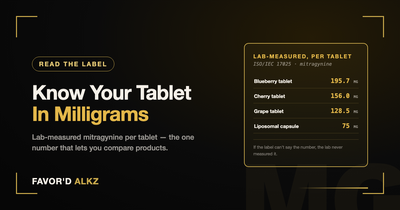
For our part as a publisher in this space, we will note one business practice rather than make any claim: Favor’d Alkz publishes third-party lab COAs and emphasizes testing transparency. We mention it only because the entire 7-OH controversy turns on a single question — what is actually in a product versus what its label says — a question of measurement, not marketing.
The arc runs from a centuries-old leaf chewed in the fields of Southeast Asia, through a plant dominated by mitragynine, to a trace metabolite that human biology amplifies, to a very recent wave of concentrated products that look nothing like the original leaf — and finally to a regulatory fight still being written. It is worth telling carefully, because so much of the public conversation collapses its very different stages into one.
Research & sources: kratom leaf chemistry and 7-OH facts in this article are drawn from peer-reviewed literature and primary regulatory sources.
- Takayama (2004), Chem. Pharm. Bull. — alkaloid profile of Mitragyna speciosa; 7-OH ≈2% of the alkaloid fraction
- Flores-Bocanegra et al. (2020), J. Nat. Prod. — at least 54 alkaloids identified in kratom leaf
- FDA — 7-hydroxymitragynine — the federal view of natural vs concentrated 7-OH
These statements have not been evaluated by the Food and Drug Administration. This article is for educational purposes only and is not medical advice; nothing here is intended to diagnose, treat, cure, or prevent any disease. Products discussed are intended for adults 21 and older. Laws governing kratom and 7-hydroxymitragynine vary by state and locality — check your local regulations before purchasing.
Sources
- Kratom | Plant, Drug, Effects, Use, Legality, & Facts — Encyclopaedia Britannica
- From kratom to 7-hydroxymitragynine: evolution of a natural remedy into a public-health threat — Pharmaceutical Biology (2025), via NCBI PMC
- Metabolism of a Kratom Alkaloid Metabolite in Human Plasma Increases Its Opioid Potency and Efficacy — ACS Pharmacology & Translational Science (2020), via NCBI PMC
- Kratom — StatPearls Publishing / NCBI Bookshelf (NIH)
- Kratom, mitragynine, 7-hydroxymitragynine (44th ECDD) — WHO Expert Committee on Drug Dependence Information Repository
- Pre-Review Report: Kratom (Mitragyna speciosa), mitragynine, and 7-hydroxymitragynine (44th ECDD) — World Health Organization
- FDA Takes Steps to Restrict 7-OH Opioid Products Threatening American Consumers — U.S. Food and Drug Administration
- Thailand Decriminalizes Kratom as WHO Considers Banning It — Pain News Network
Shop The New Lineup
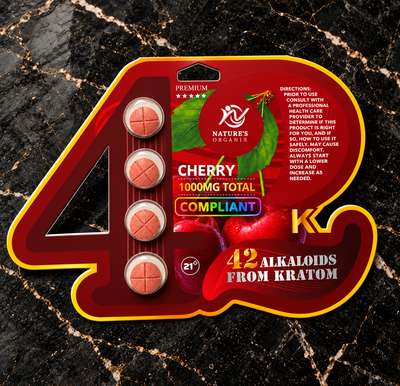
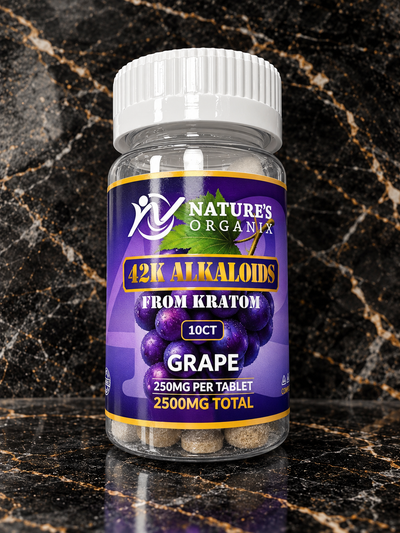
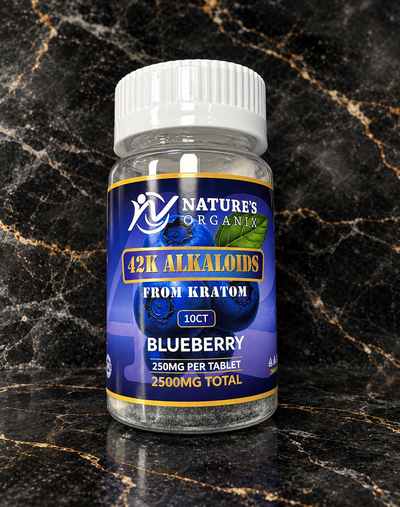
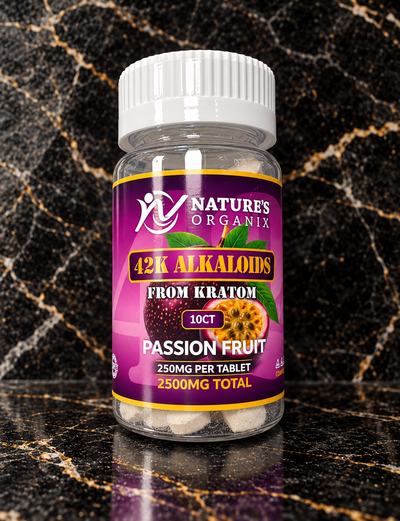
Full-spectrum, naturally derived kratom tablets and liposomal capsules — every alkaloid as the leaf made it, including naturally occurring 7-OH. Lab-tested ISO/IEC 17025; the capsule COA is published and all other certificates are available on request.
Kratom Tablets · 7-OH Ban Timeline · Lab Results
Keep Reading