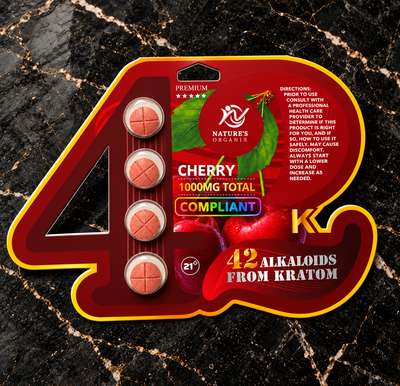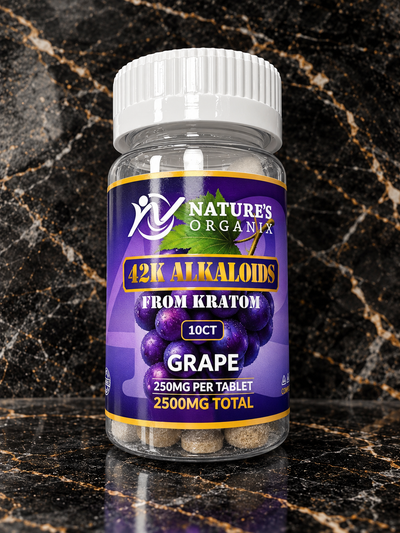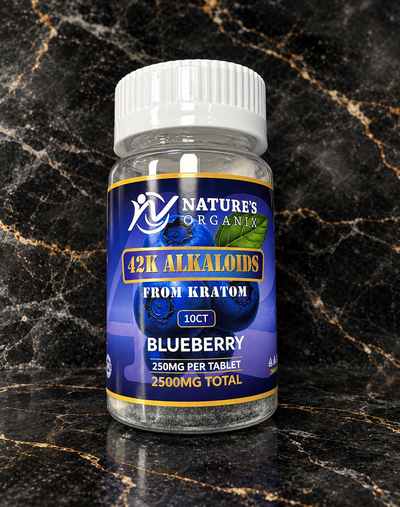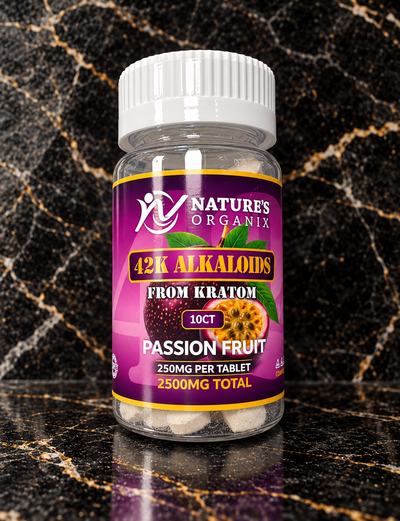

A creator plants herself in front of a wall of gleaming bottles near a convenience-store register — energy shots, "male enhancement" blister packs, brightly colored "research chemicals" — holds one up to the camera, and delivers a breathless warning: this stuff is unregulated, untested, and it could kill you. The lighting is bad, the captions are urgent, and the comment section is a chorus of horror stories. The genre has a name in the algorithm's bloodstream now: the gas-station-supplement exposé.
It is tempting to dismiss these as content-farm fearmongering, and some of them are exactly that. But the more honest reaction is more uncomfortable, because the core claim — that the shelf behind the counter contains products no one has independently verified — is, in important respects, true. The interesting question is not whether the videos are "right" or "wrong." It is figuring out precisely where the documented science ends and the vibes begin, because the line between them is also the line between useful consumer literacy and viral noise.
What the videos get right
Start with the part that is not exaggerated. The fear that supplements on convenience-store shelves can be secretly spiked with real pharmaceutical drugs is not a TikTok invention. It is a peer-reviewed finding, repeated across years.
A 2022 analysis in the Journal of Clinical Pharmacology by pharmacology researcher C. Michael White examined the U.S. Food and Drug Administration's own database of tainted supplements and found 1,068 unique products adulterated with active pharmaceutical ingredients between 2007 and 2021. The contamination was not random; it clustered heavily in sexual-enhancement and weight-loss products — exactly the categories most likely to be sold near a register, with no doctor in sight.
An earlier look at the same FDA database, covering 2007 through 2016 and summarized in US Pharmacist, sharpens the picture. Of more than 700 supplements found to contain undeclared drug ingredients, 45.5% were sexual-enhancement products, 40.9% were weight-loss products, and 11.9% were muscle-building products. The hidden drugs were not trace impurities. Sildenafil — the active ingredient in prescription erectile-dysfunction medication — turned up in 47% of the sexual-enhancement products. The withdrawn weight-loss drug sibutramine appeared in 84.9% of weight-loss products. Synthetic steroids showed up in 89.1% of muscle-building products. And 20.2% of the adulterated products contained more than one unapproved ingredient.
So when a creator says "you don't actually know what's in that bottle," they are echoing something the FDA's own records confirm. The skepticism is earned.
The market is genuinely under-policed
The second thing the videos sense correctly is that getting caught does not reliably get a product pulled. A 2022 research letter in JAMA by Pieter Cohen and colleagues followed 31 supplements that the FDA had targeted with warning letters. Years later, only 1 of the 31 (3%) had been recalled. Nine (29%) were still for sale roughly six years after the warning. And when researchers bought and tested those nine, five of them (56%) still contained at least one FDA-prohibited ingredient — including stimulants like methylsynephrine and octodrine (DMHA).
A warning letter, in other words, is not a recall. The product can keep selling, sometimes for years, sometimes still spiked. That is precisely the "the system isn't protecting you" intuition the genre runs on, and here the data backs it up.
The regulatory root cause
This is where the videos are usually directionally right but technically muddled. Many of them claim supplements are "totally unregulated." That overstates it. The more accurate — and more unsettling — reality is structural. As the U.S. Department of Defense's Operation Supplement Safety (OPSS) program explains, there are no provisions in the law for the FDA to approve dietary supplements for safety or effectiveness before they reach the consumer; by law, the manufacturer is responsible for ensuring its own products are safe before they are marketed. US Pharmacist puts the consequence bluntly:
"The FDA only becomes involved if a product is found to be adulterated or misbranded once it has already reached the market."
That is the engine behind every story in the genre. Enforcement is largely postmarket — it kicks in after a problem surfaces, after someone has already taken the product. The single most concrete example the videos point to is tianeptine, nicknamed "gas station heroin," which, as C. Michael White wrote in The Conversation in 2024, is marketed as a "dietary supplement" despite the FDA's position that it does not meet the statutory definition of a dietary ingredient — and is sold in convenience stores, gas stations, smoke shops, and online. The loophole is the product.
What the videos get wrong
If the genre stopped at "verify before you trust," it would be a public service. It rarely stops there.
The first and most corrosive flaw is overgeneralization. The same fifteen-second format that warns about a genuinely adulterated weight-loss pill is used, the next scroll down, to condemn something harmless, or to invent a danger out of thin air. The algorithm does not distinguish between a documented hazard and a manufactured one — it rewards whatever provokes a reaction. The American Lung Association, surveying viral wellness trends in 2026, offers the necessary counterweight:
"Social media should be used with extreme caution when pursuing health and wellbeing related information."
A clip's view count is not evidence. Ten million views can be ten million people watching something false.
Anecdote is not data
The genre's defining rhetorical move is the anecdote: "I saw a woman take these and end up in the ER." It is vivid, it is shareable, and it is exactly the kind of evidence regulators consider insufficient. The Federal Trade Commission's standard for health-related advertising claims — laid out in its 2022 Health Products Compliance Guidance — requires "competent and reliable scientific evidence," and treats anecdotal consumer testimonials as generally inadequate to substantiate a claim.
This produces a strange symmetry. The supplement marketer who says "thousands of happy customers swear by it" and the TikTok creator who says "I know someone this hurt" are making the same logical error in opposite directions. Both are substituting a story for proof. A trustworthy answer cannot come from either of them.
The thing both sides are circling: verification
Strip away the panic and the hype, and what is left is a single practical question: how would you actually know? The best videos in the genre stumble toward the right answer without quite naming it. OPSS names it directly:
"The only way to know the actual ingredients (or their amounts) in a dietary supplement product is through laboratory testing."
Not a label. Not a brand's reputation. Not a video's view count. Testing. And not just any testing — independent testing.
This is where the distinction between "we test our products" and "here are third-party lab results" becomes the whole ballgame. Third-party certification, as OPSS describes it, means an independent organization with no ties to the manufacturer evaluates a product and verifies that its contents match its label. The U.S. Pharmacopeia frames its USP Verified mark as a simple promise — "what's on the label is what's in the bottle" — confirmed through manufacturing audits to federal cGMP rules (21 CFR Part 111), documentation review, and off-the-shelf testing.
The reason independence matters is conflict of interest, plainly stated. As US Pharmacist notes, legitimate certification programs obtain the product "independently from a public source and not directly from the manufacturer" — which removes the incentive to hand over a cherry-picked, best-case sample. A brand testing its own carefully selected batch and a third party buying the same product off a shelf are not doing the same thing.
What a Certificate of Analysis actually is
The document that operationalizes all of this is the Certificate of Analysis, or COA. A COA can include the product identifier, the batch number, manufacturer information, the specifications being tested against, testing dates, the methodology used, and the actual results for contaminants and potency. The crucial feature is that a good COA is batch-specific: it shows results for one individual production run, not a generic marketing claim that applies to nothing in particular.
One honest caveat, again from OPSS: third-party verification confirms that a product's contents match its label. It does not prove the product is safe or effective. A COA tells you what is in the bottle. It does not tell you that what is in the bottle is good for you. Those are different questions, and conflating them is its own kind of error.
Applying the standard evenhandedly — including to ourselves
It would be easy, and dishonest, for a company that sells concentrated kratom-derived products to write all of this and quietly imply that our shelf is the exception. So let me be explicit, because the entire logic of this essay collapses if it is applied selectively.
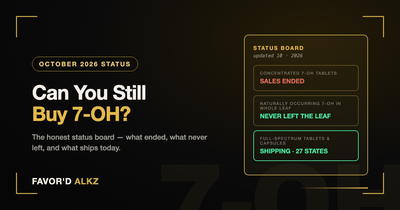
Favor'd Alkz sells products containing 7-hydroxymitragynine (7-OH), and 7-OH is sold in many of the same retail channels — smoke shops, convenience stores, online — as the products these videos target. The "verify, don't trust virality" standard applies to it in full, with no carve-out.
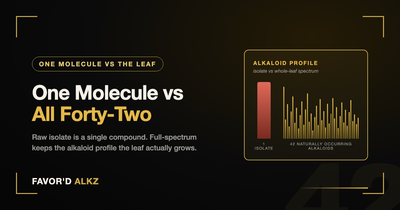
Here is the honest science. A 2025 review in Pharmaceutical Biology (Alsbrook, Pro and Koturbash) describes 7-OH as a minor alkaloid that generally makes up less than 2% of the total alkaloid content in raw kratom leaf. Commercial 7-OH products are not leaf — they are chemically enriched, produced by converting mitragynine isolates or extracts, which makes them chemically and pharmacologically distinct from traditional kratom. That same review characterizes 7-OH as a potent mu-opioid receptor agonist with substantially higher receptor binding affinity than mitragynine, and concludes that concentrated 7-OH products are "pharmacologically and toxicologically distinct from kratom leaf and pose significant risks of morbidity and mortality under typical conditions of use." The FDA has publicly raised concerns specifically about concentrated 7-OH products and has stated that 7-OH is not a lawful dietary ingredient.
The science here is still developing and genuinely contested, and it should be reported that way — as ongoing uncertainty, not as a settled verdict in either direction. Legality varies by state and locality. These products are for adults 21 and older. None of that is softened by the fact that a brand publishes its lab work.
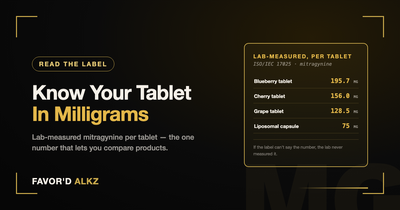
What a brand can responsibly do is treat testing transparency as a baseline business practice rather than a marketing flourish: Favor'd Alkz publishes third-party lab COAs for its products. That is a statement about labeling and content verification — what is in the bottle, in a given batch — and nothing more. It is not, and cannot be, a claim that the contents are safe, healthy, or beneficial. The whole point of this essay is that those are separate questions that no label and no video can answer for you.
The defensible takeaway
So here is where the analysis lands. The viral gas-station-supplement genre is right about the disease and wrong about the diagnosis. It is right that "unregulated, untested, mislabeled" describes a real, documented hazard in this marketplace — the adulteration data, the warning-letter follow-ups, and the postmarket structure of FDA oversight all confirm it. It is wrong when it treats every product behind every counter as identical, and wronger still when it substitutes a view count for evidence.
It helps to keep three different things separate, because the videos routinely smear them together: (a) products secretly spiked with hidden pharmaceutical drugs, (b) products that are simply mislabeled or off on potency, and (c) legal-but-controversial novel ingredients like 7-OH whose science is still being worked out. These are distinct problems with distinct evidence, and conflating them is how a video stops informing and starts misleading.
The rational response to all of it is the same, and it is unglamorous: do not trust a product label, and do not trust a viral clip. Ask for published, batch-specific, third-party lab results — and read them. That standard is the antidote to both real adulteration and to vibes-based fear. It is also the only standard that survives being applied to everyone, including the people writing the essay.
These statements have not been evaluated by the Food and Drug Administration. This article is for educational purposes only and is not medical advice; nothing here is intended to diagnose, treat, cure, or prevent any disease. Products discussed are intended for adults 21 and older. Laws governing kratom and 7-hydroxymitragynine vary by state and locality — check your local regulations before purchasing.
Sources
- Continued Risk of Dietary Supplements Adulterated With Approved and Unapproved Drugs: Assessment of the US FDA's Tainted Supplements Database 2007 Through 2021 — Journal of Clinical Pharmacology (C. Michael White), via PubMed/NCBI
- Hundreds of Supplements Have Undeclared, Potentially Harmful Ingredients — US Pharmacist
- Recalls, Availability, and Content of Dietary Supplements Following FDA Warning Letters — JAMA (Cohen, Avula, Katragunta, Khan), via PMC/NCBI
- Popularly known as 'gas station heroin,' tianeptine is being sold as a dietary supplement — with deadly outcomes — The Conversation (C. Michael White, Univ. of Connecticut)
- Why doesn't FDA stop unsafe supplements from reaching the market? — Operation Supplement Safety (OPSS), U.S. Department of Defense
- Why is Third-Party Certification Important for Dietary Supplements? — Operation Supplement Safety (OPSS), U.S. Department of Defense
- Dietary Supplements Verification Program (USP Verified) — U.S. Pharmacopeia (USP)
- Determining the Quality of Dietary Supplements — US Pharmacist
- Health Products Compliance Guidance (2022) — U.S. Federal Trade Commission (FTC)
- Popular TikTok Trends to Avoid: The Dangers of Viral Wellness — American Lung Association
- From kratom to 7-hydroxymitragynine: evolution of a natural remedy into a public-health threat — Pharmaceutical Biology (Alsbrook, Pro & Koturbash, 2025), via PMC/NCBI
Research & sources: kratom leaf chemistry and 7-OH facts in this article are drawn from peer-reviewed literature and primary regulatory sources.
- Takayama (2004), Chem. Pharm. Bull. — alkaloid profile of Mitragyna speciosa; 7-OH ≈2% of the alkaloid fraction
- FDA — 7-hydroxymitragynine — the federal view of natural vs concentrated 7-OH
- Favor'd Alkz Regulation Map — current state-by-state shipping status
Shop The New Lineup
Full-spectrum, naturally derived kratom tablets and liposomal capsules — every alkaloid as the leaf made it, including naturally occurring 7-OH. Lab-tested ISO/IEC 17025; the capsule COA is published and all other certificates are available on request.
Kratom Tablets · 7-OH Ban Timeline · Lab Results
Keep Reading