
Quick answer: "Liposomal" describes a delivery format, not a stronger product. In Nature's Alks capsules the leaf's naturally derived alkaloid extract is carried inside phospholipid vesicles (liposomes), the same lipid-bilayer structure that makes up cell membranes. The capsule is lab-quantified at 39.6 mg mitragynine and 68.8 mg total alkaloids, with 0.39 mg of naturally occurring 7-OH. 42 Alkz tablets deliver the same full-spectrum profile in a plain compressed tablet, 128.5–195.7 mg mitragynine depending on flavor. Neither product contains synthetic or semi-synthetic alkaloids. 21+ only.
Two products, one plant extract, two very different ways of packaging it. This guide explains what liposomal technology actually is, what it changes about a capsule and what it does not, what "naturally derived" means on our labels, and how the Nature's Alks 75mg liposomal capsules and the 42 Alkz full-spectrum tablets compare line by line.
What a liposome is
A liposome is a microscopic sphere made of phospholipids, the same two-tailed fat molecules that form every cell membrane in the body. Put phospholipids in water and they arrange themselves into a bilayer: water-loving heads facing out, fat-loving tails tucked inside. Close that sheet into a ball and you have a vesicle with a watery core and a fatty shell. Liposomes were first described in the 1960s and have been used since the 1990s as a carrier format in pharmaceuticals and, more recently, in dietary supplements.
In a liposomal supplement, the active material is loaded into or between those layers during manufacturing. The finished product is then dried, blended with a carrier, and filled into capsules. That is the whole of what "liposomal" means on a label: the alkaloid extract is formulated inside a phospholipid carrier instead of being pressed into a dry tablet or poured loose into a capsule.
Why manufacturers use it
The published rationale for liposomal formats comes down to three properties of the phospholipid shell. We describe them here as formulation chemistry, which is what the peer-reviewed literature supports, not as claims about what the capsule does in a person.
- Dispersibility. Plant alkaloids are often poorly water-soluble. A phospholipid shell lets a lipophilic compound disperse evenly in a water-based environment instead of clumping.
- Protection of the payload. The bilayer physically separates the encapsulated material from its surroundings, which is why the format is used for compounds that degrade in acidic or oxidising conditions.
- Consistency. Encapsulation happens before the capsule is filled, so each capsule carries the same ratio of carrier to extract. Our COA confirms that per-capsule alkaloid content, not the manufacturing step.
What the format does not change is the chemistry of the alkaloids themselves. Mitragynine inside a liposome is the same molecule as mitragynine in a tablet. The lab panel measures it the same way in both.
What is inside a Nature's Alks capsule
The current lot is quantified by an ISO/IEC 17025-accredited laboratory on a 9-analyte HPLC panel. The certificate of analysis is published on the product page.
| Per capsule | Lab result |
|---|---|
| Mitragynine | 39.6 mg |
| Total kratom alkaloids | 68.8 mg |
| 7-hydroxymitragynine (naturally occurring) | 0.39 mg (0.56–0.71% of total alkaloids) |
| Net fill weight | 650 mg |
| Capsules per bottle | 18 |
| Synthetic or semi-synthetic alkaloids | None |
The "75mg" on the front of the bottle refers to the mitragynine extract input per capsule; the number that travels between products and brands is the lab-measured 39.6 mg of mitragynine, which is why we print both. The 7-OH figure matters for one reason: it is naturally occurring in the leaf, present at well under 1% of the alkaloid fraction, and far below every state cap we ship under.
What "naturally derived" means on our labels
Every alkaloid in both products comes from Mitragyna speciosa leaf through food-grade extraction. Nothing is synthesised, converted, or concentrated beyond the leaf's own profile. In practice that means three things you can check on the COA:
- Mitragynine is the dominant alkaloid, as it is in the leaf. In a converted or "semi-synthetic" product, 7-OH or another single alkaloid dominates instead.
- 7-OH stays at trace levels, 0.56–0.71% of total alkaloids across our line. The leaf makes very little of it, so a naturally derived extract carries very little of it.
- The minor alkaloids are present. Paynantheine, speciogynine, speciociliatine, mitraciliatine and the rest show up on a full panel because nothing was stripped out to isolate one molecule.
This is the distinction state consumer-protection laws draw. Arizona, Colorado, Nebraska, Oklahoma, South Dakota, Texas and Wyoming all cap 7-OH as a share of total alkaloids and bar synthesised alkaloids; a naturally derived full-spectrum product passes those tests by definition. Our regulation map shows the current status in every state.
The 42 Alkz tablets, side by side
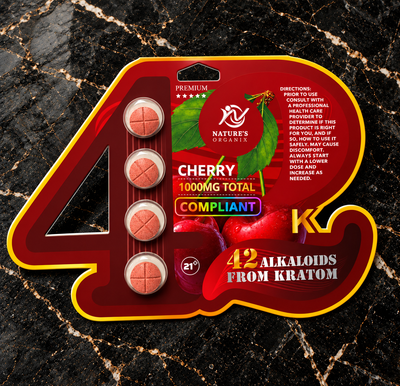
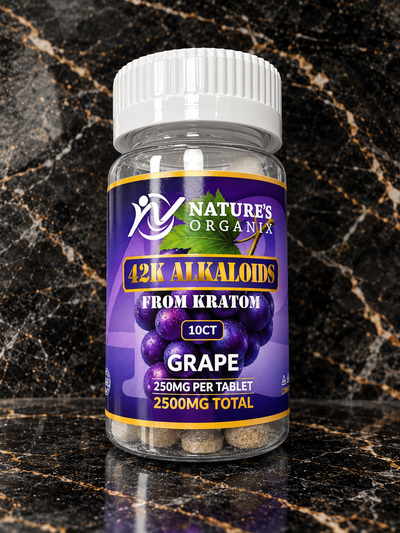
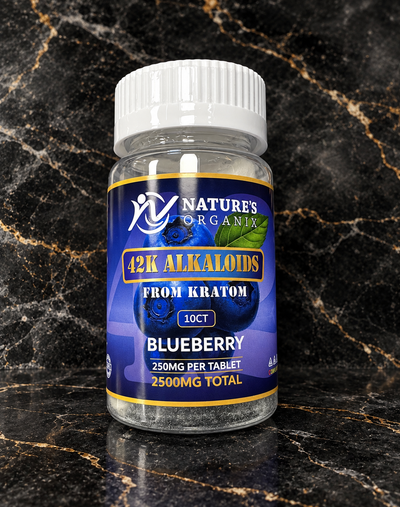
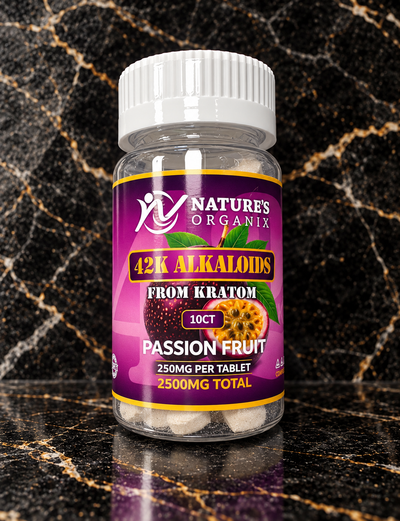
The tablets are named for the 42 best-documented kratom alkaloids, which we list with citations in Raw 7-OH vs Full-Spectrum Kratom Tablets. Same extraction, same lab panel, no phospholipid carrier: the extract is blended with tablet excipients and compressed. Because a tablet carries no carrier material, it holds more alkaloid per unit.
| Product | Format | Mitragynine per unit | Total alkaloids per unit | Units per pack |
|---|---|---|---|---|
| 42 Alkz Blueberry | Compressed tablet | 195.7 mg | 307 mg | 4 or 10 |
| 42 Alkz Cherry | Compressed tablet | 156.0 mg | 244.8 mg | 4 |
| 42 Alkz Grape | Compressed tablet | 128.5 mg | — | 4 or 10 |
| 42 Alkz Passion Fruit | Compressed tablet | 195.7 mg | 307.0 mg | 10 |
| Nature's Alks 75mg | Liposomal capsule | 39.6 mg | 68.8 mg | 18 |
Read the mitragynine column, not the format. A Blueberry tablet carries roughly five times the mitragynine of one capsule; the capsule's point is the carrier and the smaller, more divisible unit, not a higher number. How to read per-unit milligrams in general is covered in Mitragynine Tablets: Reading mg Per Tablet.
Where each one ships
Because the capsule carries 0.39 mg of 7-OH per unit, it clears both the 1 mg-per-serving and the 1 mg-per-gram rules that several states adopted in 2026. The 42 Alkz tablets are quarter-scored, so a labeled serving is one quarter tablet at 0.34–0.43 mg of 7-OH, which clears the per-serving rules in Virginia and Maryland. They do not clear Florida's per-gram rule, which divides by tablet mass. As of October 16, 2026, capsules ship to 31 states and the tablets to 30; Florida takes capsules only. Checkout applies the rule automatically to your ship-to address, and the shipping map shows it per product.
What we will not claim
You will see liposomal supplements marketed with absorption multipliers and other performance language. We do not make those claims for Nature's Alks, and we do not make any claim about what either product does for a person. What we publish is what a laboratory can measure: milligrams of each alkaloid per unit, the absence of synthetic alkaloids, and the lot number that ties the capsule in your hand to that certificate. Everything else is formulation chemistry, described above, and your own decision.
FAQ
Is liposomal the same as "extract"?
No. Both products are extracts. "Liposomal" only describes how the capsule's extract is carried, inside phospholipid vesicles.
Does the liposomal capsule contain more alkaloid than a tablet?
No. One capsule carries 39.6 mg mitragynine; one 42 Alkz tablet carries 128.5–195.7 mg depending on flavor.
Are the phospholipids from soy or sunflower?
Email support@favordalkz.com with your lot number and we will send the carrier specification for that lot if you have an allergy concern.
Is the 7-OH in these products added?
No. It is the leaf's own trace alkaloid, measured at 0.56–0.71% of total alkaloids. No alkaloid is added, converted, or synthesised.
Why does the capsule ship to more states than the tablets?
Florida measures 7-OH per gram of product. The capsule sits at 0.598 mg/g, under the 1 mg/g line; a 0.75 g tablet carrying 1.36–1.72 mg does not. Virginia and Maryland measure per serving, which the quarter-scored tablets pass.
These statements have not been evaluated by the Food and Drug Administration. These products are not intended to diagnose, treat, cure, or prevent any disease. For adults 21 and older. Informational only; not medical or legal advice.