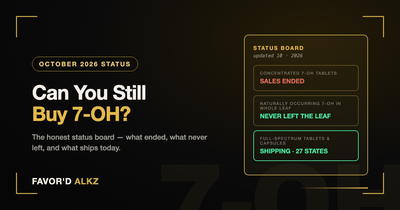

Short answer: No, concentrated 7-OH is not federally banned as of September 2026.
On July 1, 2026, the DEA filed two Notices of Intent to temporarily place 7-OH (above a set threshold) and three analogues into Schedule I. Those notices publish in the Federal Register on July 6, 2026, and the temporary order could not take effect until at least 30 days later — meaning on or after roughly August 5, 2026. Until then, 7-OH remains federally legal.
If you have seen headlines saying "7-OH is banned," the reality is more specific — and the exact dates matter. This is a factual explainer of what the DEA actually filed, when each step happens, and what the notice does and does not cover. It is not legal advice, and it makes no health or effect claims of any kind. It is strictly about legal status and timing.
Is 7-OH banned right now?
Status update — September 4, 2026: The analogues named in DEA-1644 — mitragynine pseudoindoxyl, MGM-15 and MGM-16 — are no longer sold by Favor’d ALKz, and those products have been withdrawn from sale. DEA-1570 concerns 7-OH and is a separate docket. Timeline statements elsewhere on this page describe the position as at the date they were written and may not reflect the current record. For current state-by-state status see our Kratom Regulation Map. Informational only; not legal advice.
No. As of July 4, 2026, 7-hydroxymitragynine (7-OH) is not a federally scheduled controlled substance. The DEA has announced its intent to schedule it on a temporary (emergency) basis, but an intent is not the same as an enforceable ban. Several procedural steps still have to occur before any prohibition takes legal effect, and those steps are described below.
State and local rules can differ from federal status, and they can change quickly. Nothing here overrides your own state or municipal law, and you should confirm the rules where you live.
What did the DEA file on July 1, 2026?
On July 1, 2026, the DEA submitted two separate Notices of Intent to temporarily place the following into Schedule I of the Controlled Substances Act:
- 7-OH (7-hydroxymitragynine) above a specified threshold — Docket DEA-1570.
- Three analogues: mitragynine pseudoindoxyl, MGM-15, and MGM-16 — Docket DEA-1644.
A "Notice of Intent" is the first formal step in the DEA's temporary (emergency) scheduling process. It signals what the agency plans to do; it does not, by itself, make anything illegal on the day it is filed.
When do the notices publish, and what is the ban date?
Here is the timeline as filed:
- July 1, 2026 — DEA files the two Notices of Intent.
- July 6, 2026 — The notices publish in the Federal Register: DEA-1570 for 7-OH (91 FR 40917) and DEA-1644 for the analogues (91 FR 40909).
- On or after ~August 5, 2026 — The earliest date a temporary Schedule I order could take effect. By law, a temporary order cannot take effect until at least 30 days after the July 6 publication.
So there is no single "ban date" that has already passed. The soonest a temporary order could have become enforceable was roughly August 5, 2026, and only after the DEA issues the actual order following the notice period.
How long would a temporary ban last?
A temporary Schedule I placement has an initial term of two years, which the DEA may extend by up to one additional year (three years total). Temporary scheduling is designed as a stopgap. Making a substance permanently Schedule I requires a separate, formal rulemaking process — and as of September 2026, that permanent process has not been started.
Note on the second docket: the DEA-1644 order covering mitragynine pseudoindoxyl, MGM-15 and MGM-16 took effect 26 August 2026 and runs to 26 August 2028. The DEA-1570 threshold action covering 7-OH is separate and, as of September 2026, no order had been published in the Federal Register.
What material does the notice actually cover?
The threshold in the notice is specific. Covered material means:
- Mitragyna speciosa plant material containing more than 0.050% 7-OH by dry weight; OR
- Any extract, concentrate, edible, or pressed product containing more than 0.050% 7-OH by weight, or more than 1.00 mg of 7-OH per package or article.
Importantly, natural kratom leaf is explicitly not targeted by this action and remains federally legal. The notices are aimed at concentrated 7-OH material above the thresholds above, not the raw botanical leaf.
Is there also an HHS comment period?
Yes. A related HHS Request for Information (docket HHS-OASH-2026-0232; 91 FR 41049) is open for public comment through July 31, 2026. A Request for Information gathers input; it is separate from the DEA's scheduling action and does not itself ban anything.
Has anyone sued to stop the scheduling?
As of August 10, 2026, no lawsuit challenging the scheduling had been filed. We have not re-checked the litigation docket since that date. Industry groups have publicly stated they are "reviewing options." If that changes, the timeline and outcome above could be affected, so it is worth watching the docket entries directly.
How did we get here? A short background
The July 2026 notices did not come out of nowhere. Publicly reported milestones leading up to them include:
- July 2025 — FDA sent warning letters related to 7-OH products.
- Late July 2025 — FDA/HHS recommended scheduling.
- August 2025 — Florida issued a state emergency rule.
- December 2025 — FDA/DOJ conducted product seizures.
Taken together, these steps set the stage for the DEA's July 2026 Notices of Intent.
What does this mean for consumers right now?
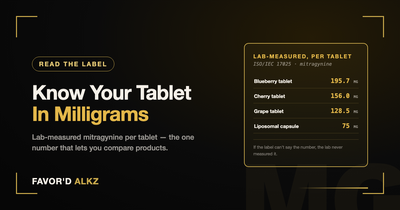
As of July 4, 2026, 7-OH products above the threshold are not federally prohibited, but the situation is actively developing and the earliest possible effective date for a temporary order is about a month out. Consumers who want to understand exactly what they are buying can review third-party lab documentation, including potency figures, on our lab results page. You can also see current product formats on our tablets collection. Wholesale buyers can visit 7ohblack.com.
We will continue to follow the Federal Register dockets and update as the process moves. For the primary sources, the docket numbers and Federal Register citations listed above are the authoritative references.
These statements have not been evaluated by the Food and Drug Administration. This product is not intended to diagnose, treat, cure, or prevent any disease. For adults 21 and older, where legal.
Frequently asked questions
Is 7-OH banned in 2026?
No. As of July 4, 2026, 7-OH is not federally banned. The DEA filed Notices of Intent to temporarily schedule it on July 1, 2026, but the earliest any temporary order could take effect was on or after approximately August 5, 2026, a date that has now passed with no order published.
What is the 7-OH ban date?
There is no ban date that has already taken effect. The notices publish in the Federal Register on July 6, 2026, and a temporary Schedule I order could not take effect until at least 30 days later — meaning on or after roughly August 5, 2026.
Is 7-OH being placed in Schedule 1?
The DEA has filed to place 7-OH and three analogues (mitragynine pseudoindoxyl, MGM-15, MGM-16) into Schedule I on a temporary basis. Temporary placement lasts up to two years (extendable to three). Permanent Schedule I placement would require a separate rulemaking that has not started.
Is natural kratom leaf affected?
No. Natural kratom leaf is explicitly not targeted by these notices and remains federally legal. The action focuses on concentrated 7-OH material above defined thresholds.
Is 7-OH still legal to buy today?
Federally, 7-OH is not a scheduled controlled substance as of September 2026. State and local laws can differ and can change, so confirm the rules where you live. Products are intended for adults 21 and older, where legal.
Research & sources: kratom leaf chemistry and 7-OH facts in this article are drawn from peer-reviewed literature and primary regulatory sources.
- FDA — 7-hydroxymitragynine — the federal view of natural vs concentrated 7-OH
- Takayama (2004), Chem. Pharm. Bull. — alkaloid profile of Mitragyna speciosa; 7-OH ≈2% of the alkaloid fraction
- Favor'd Alkz Regulation Map — current state-by-state shipping status
Shop The New Lineup
Full-spectrum, naturally derived kratom tablets and liposomal capsules — every alkaloid as the leaf made it, including naturally occurring 7-OH. Lab-tested ISO/IEC 17025; the capsule COA is published and all other certificates are available on request.
Kratom Tablets · 7-OH Ban Timeline · Lab Results
Keep Reading